

CHAPTER 4
The Aftermath
Childress flew out on the same chopper as Watkins. Despite shrapnel wounds across his face, neck and legs, and a gunshot wound, Childress remained unfazed. Now, he continued minimizing his injuries in the presence of his gravely wounded platoon sergeant.
“I don’t know how Watkins didn’t die,” he remembered. “I mean somebody blew him up and shot him at the same time, then he sat in the back of that 7-ton stuffing gauze into his own open-cavity wound. How did he live and breathe through that? He’s a machine. When our Blackhawk got to the hospital and they took us inside, I could see him starting to fade. When we got into the same room, I heard his monitor flatline. I freaked out. They shocked him and brought him back, but he died for a split second there in the hospital.”
Corbin’s swift actions in scooping Watkins off the ground and returning him to the relative safety of the 7-ton played a key role in Watkins’ survival. Indeed, Corbin made more than five trips back and forth through the ambush site carrying, dragging, or assisting casualties back to his vehicle. Miraculously, he remained uninjured.
Mayer stuck by Corbin’s side for the remainder of the ambush once they met up, surviving the hail of gunfire in addition to walking away from the initial blast. He spent two weeks at the hospital in Al Asad before returning to Corbin, Schuller, and the few other Marines remaining from the original MAP 7 group.
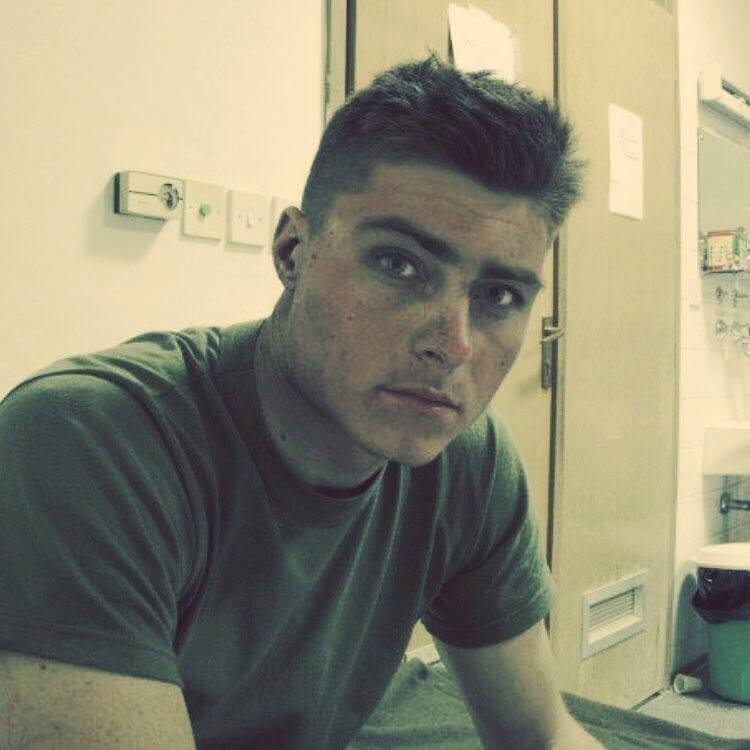
Taken a few hours after the ambush, Stan Mayer stares blankly at the camera while recovering at the hospital. He miraculously survived the explosion and would return to MAP 7 just 2 weeks later. Mark Kalinowski
“When I got back to the dam, the platoon was all gone,” Mayer said. “They had already gotten a shipment of combat replacements, a batch of 19-year-olds straight out of God knows where, and they were already out there patrolling again with Jeff and Todd. My little cubicle of a room at the dam was Mike Marzano, Aaron Cepeda, me, and Sgt Watkins. I got back and they were all gone. I was staring at two empty racks, those guys were dead. The one above mine, that guy was hit a bunch of times and he’s gone. I spent like a week in the dark smoking cigarettes with their ghosts until the platoon finally got back and Jeff came and found me.”
SSgt Brady named Mayer as Watkins’ replacement for platoon sergeant. He and Schuller took the lead for the remainder of the deployment conducting operations and raising their new replacements. Their experience on May 7th dictated their every decision for the remaining five months of the deployment.
The ambush served as a catalyst for a marked turn towards chaos in Haditha. Violence escalated through the summer and on Aug. 1, six Marine Scout Snipers were overrun and killed in their hide on the outskirts of the city. 3/25 launched Operation Quick Strike in response. Two days later at the outset of the operation, an AAV struck an IED just outside the city killing 14 Marines and an Iraqi interpreter loaded inside. The tragedy marked the start of a three day period in which the battalion suffered 19 KIA. By the time Mayer, Schuller, and Corbin rotated out of Iraq with the rest of the battalion in September, 3/25 suffered 48 total killed and more than 150 wounded.
“This story, weaving together disjointed strands into a solitary rope, illuminates the truth of what actually happened to us, maybe for the first time, because those of us who were there will talk about anything but, and the truth is the last gate between us and the peace we all seek.”
— Stan Mayer
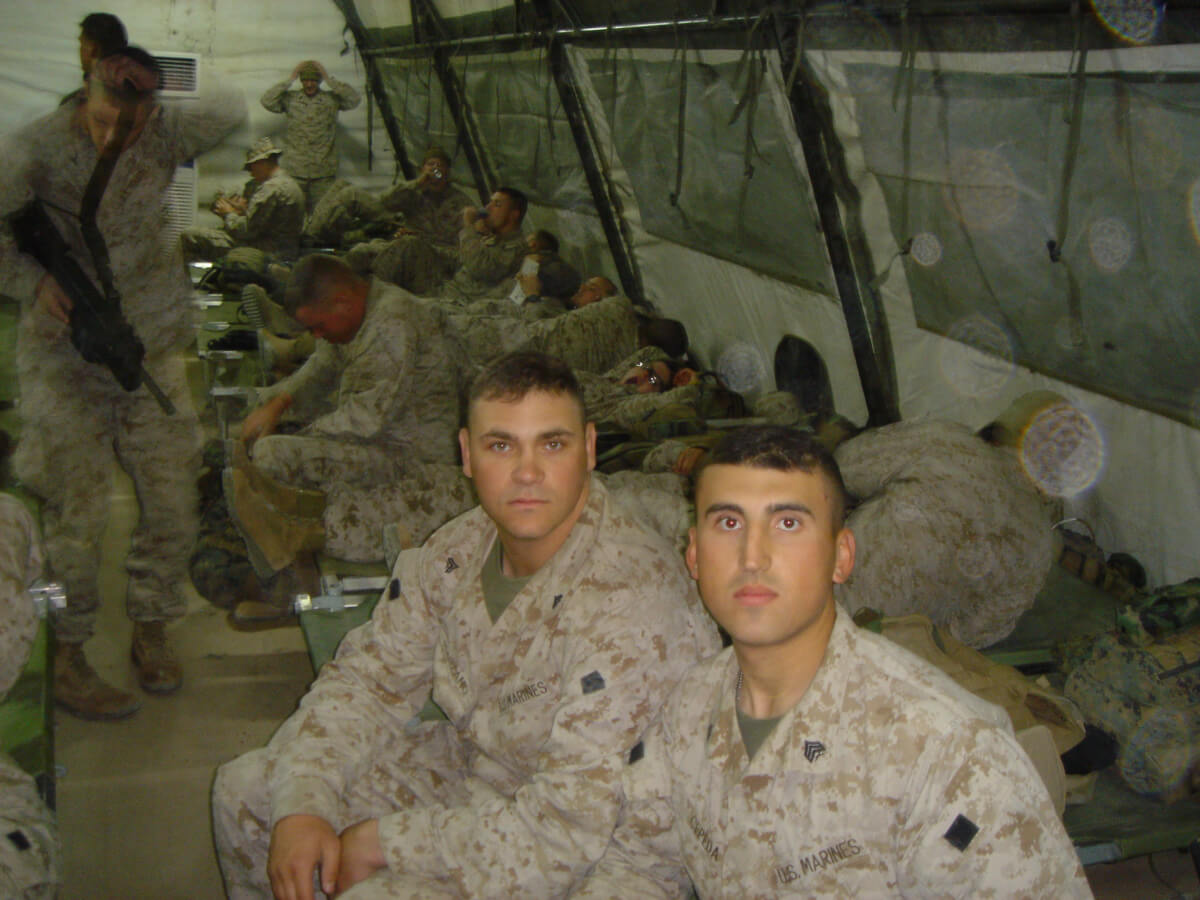
Sgt Michael A. Marzano, left, and Sgt Aaron N. Cepeda, right, were both killed during the ambush on May 7th. Marzano, 28 years old, formerly served as an active duty mortarman. Cepeda, 22 years old, was a double-major in college on his way to medical school. Courtesy of Randall Watkins
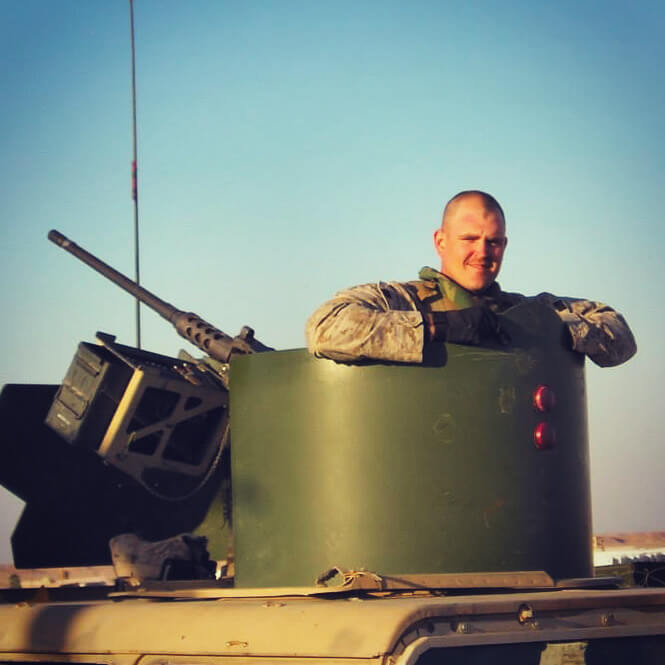
LCpl Lance T. Graham in the gunner’s turret of his humvee in Iraq. Graham was killed during the May 7th ambush. He was 26 years old. Courtesy of Stan Mayer
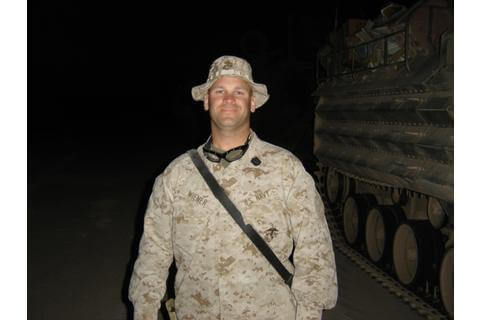
HM3 Jeffery L. Wiener, died in the ambush on May 7. Formerly a firefighter and paramedic in New York, Wiener joined the military in the wake of the terrorist attacks on Sept. 11, 2001. He was 32 years old. Courtesy of Randall Watkins
The ambush on May 7th endures today as a defining event for the Marines who experienced it, though it can hardly be found as more than a footnote in broader histories of the war. The personal awards that emerged reinforce its significance. Mayer received a Navy Commendation Medal with Combat “V” for his actions, while Childress received a Bronze Star with “V.” For his outstanding courage and dedication in remaining in the turret and suppressing the ambush, Schuller received a Silver Star. For his actions moving repeatedly around the kill zone and rescuing his fellow Marines, Corbin received the Navy Cross. Today, the survivors serve their families, communities, and some still the Corps on active duty, guided by the lasting impressions developed in the wake of the attack.
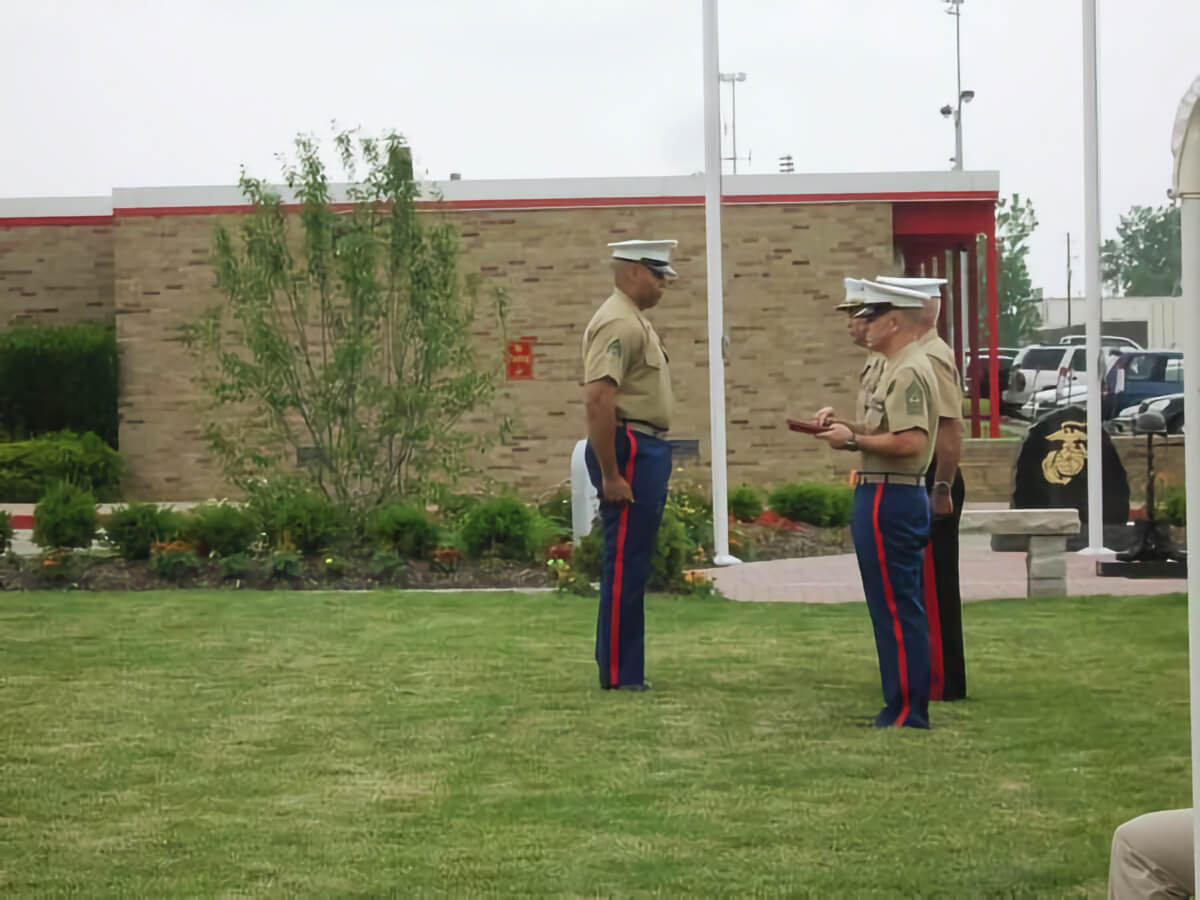
Numerous personal awards came out of the May 7th ambush. In addition to a Navy Commendation Medal with “V,” Bronze Star with “V,” and a Silver Star, Todd Corbin, left, was awarded the Navy Cross. Courtesy of Stan Mayer
“That incident has kept the reality of what we do as Marines at the front of my mind,” Schuller reflected. Today, he serves on the training staff of Marine Corps Air Ground Combat Center, Twentynine Palms, Calif., preparing Marines for deployment. “All I think about every day while we’re training Marines is are we getting mentally and physically prepared to win wars. In my mind, that should be our priority; to win wars and bring our brothers and sisters home.”
“This thing has completely changed us,” Mayer reflected. “Jeff and I used to say, ‘don’t let this thing define us. If we’re still talking about this 10 years from now I want you to punch me.’ Yet here we are 20 years later. No matter what we do, these 45 minutes in May back when we were kids defined us, and always will. Everything we do now is on behalf of those guys who didn’t make it. That’s the driving force. Lance Graham is dead, and so is Mike Marzano, Aaron Cepeda, and Jeff Wiener. So are 44 other of our buddies in the battalion, not to mention everyone else in that war. Those four guys I knew personally and they were so much better than us. Far be it from me to waste my bonus life feeling bad for myself or being an asshole. They don’t get that choice.
We are much older men in a much different place in our lives, but a lot of us have not processed our shit in the right way. A lot of us are still struggling, and that breaks my heart. You can’t just bring everyone to the right place, you have to seek it out yourself. I’ve found different ways to process my shit by exposing it, talking about it, and working through it, but I still don’t exactly know what my shit is. This story, weaving together disjointed strands into a solitary rope, illuminates the truth of what actually happened to us, maybe for the first time, because those of us who were there will talk about anything but, and the truth is the last gate between us and the peace we all seek.”
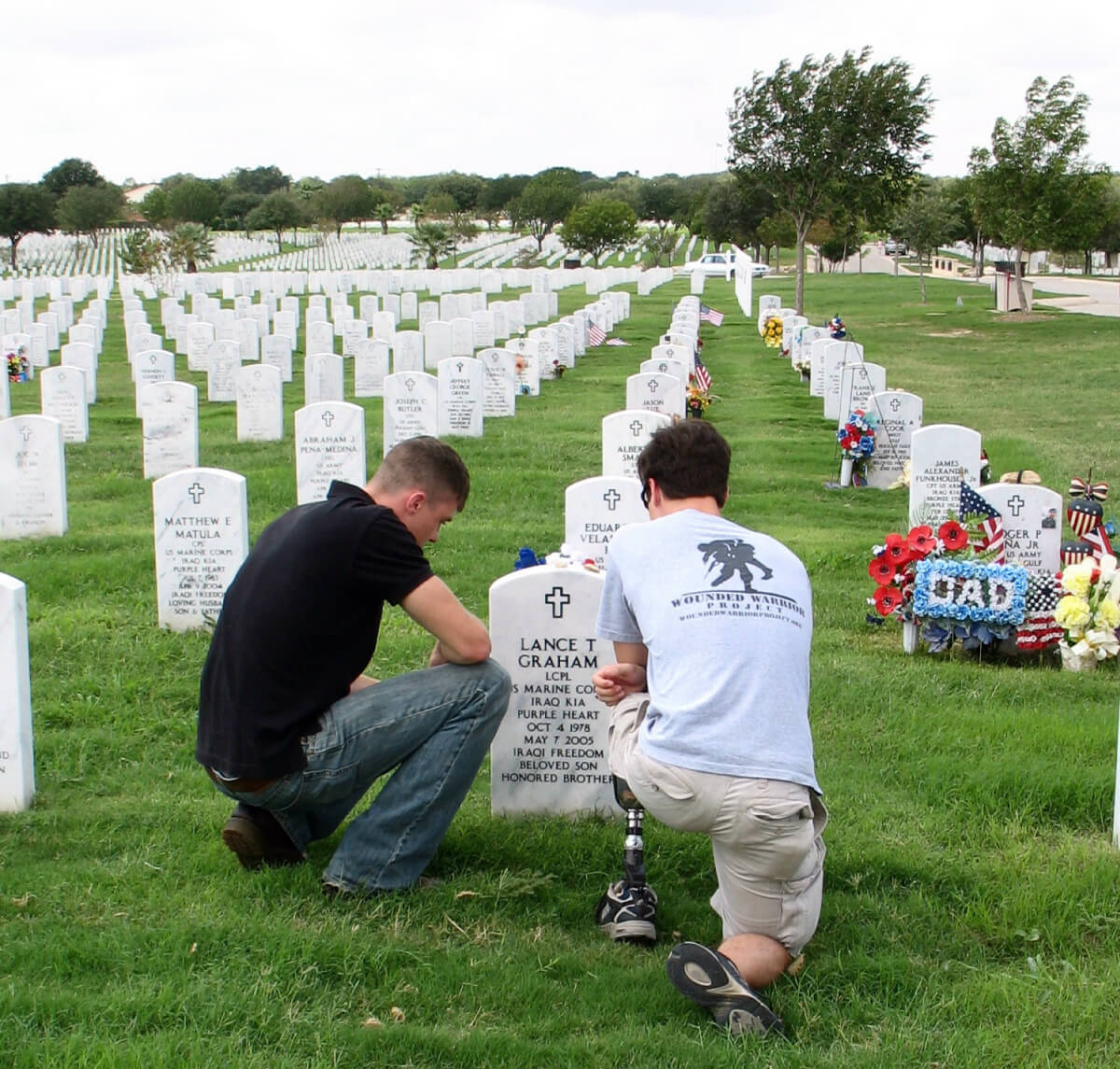
Stan Mayer, left, and Aaron Rice, right, visit the grave of Lance Graham at Fort Sam Houston National Cemetery. Courtesy of Randall Watkins
Originally published in Leatherneck magazine, May 2025.
To join the comments on this story, return to the Ambush In Haditha story home page. Thank you for taking part in these veterans' story.