

Ambush in Haditha
A Footnote from Iraq
By Kyle Watts
Author’s Note: To the Marines of MAP 7, thank you for entrusting me with your experiences and allowing me to share them. I hope what follows may appropriately honor the memory of your fallen, and elevate your service towards the level of recognition it deserves. Semper Fidelis.
CHAPTER 1: The POGs
In late 2004, Sergeant Randall Watkins faced the most unusual tasking of his Marine Corps career. An active duty infantry squad leader turned prospective officer candidate, now Watkins found himself in a POG (Person Other than Grunt) reserve unit with orders to create an infantry platoon out of the cooks, clerks, and mechanics surrounding him.
Watkins left active duty earlier that year to finish college and achieve his goal of becoming a Marine Officer. Tumultuous events in Iraq, however, upended his plans. The war would end soon, he believed. If he wanted in on the action, he had to get back in uniform and over there now. Watkins dropped out of school in his home state of Texas and joined the nearest reserve unit, 4th Reconnaissance Battalion, out of San Antonio. Despite his infantry background and active duty experience, 4th Recon did not have a place for him. The battalion shipped Watkins and numerous others like him to Twentynine Palms, Calif., to fill out another reserve unit preparing for war.
The 3rd Battalion, 25th Marine Regiment, 4th Marine Division, gathered there for pre-deployment training and time was running short. Based in Ohio, the battalion was activated to fight in Iraq and called up Marines sprinkled across the country. Even now gathered at full strength, 3/25 came up short handed. Officers planning the deployment faced another problem. Their future area of operation spanned a huge swath of Anbar province, the Wild West of Iraq. To adequately cover the zone, they needed highly mobile, heavily armed small units capable of speeding throughout the area at a moment’s notice. The battalion’s leaders devised the Mobile Assault Platoons (MAPs) to fill the gap.
When Watkins showed up, 3/25 assimilated him into Headquarters and Service (H&S) Company. He rued the prospect of an Iraq deployment trapped inside the wire with headquarters, until one day when everything changed. Battalion command tapped Staff Sergeant Michael Brady, another former infantryman and long-time 3/25 member, to be the new platoon commander for MAP 7. Watkins, by coincidence in the company office as the conversation took place, was named platoon sergeant. In addition to its “mobile assault” function, an ambiguous role still being defined, MAP 7 would act as the battalion’s Personal Security Detail for the officers and senior enlisted leaders traveling around Iraq. Whatever its role might turn out to be became the primary problem for Brady. Watkins’ responsibility was to create the platoon from scratch.
The available pool from which to select Marines proved woefully limited. Infantrymen were not available. Instead, the battalion offered mechanics, truck drivers, cooks, or any other Marine Watkins wanted from H&S Company. He began with the highest scores on the rifle range and physical fitness test. Beyond those basic qualifications, he scrutinized civilian jobs, looking for any Marine employed or trained in anything remotely “Marine.”
“Mobile Assault Platoon 7 was not infantrymen, it was ‘every Marine a rifleman.' Watkins was not happy that he didn’t have infantrymen and he would be damned if he didn’t make us into the infantrymen he wanted."
— Stan Mayer
The candidates’ lack of face value belied the prior service or civilian roots of numerous H&S Marines that distinguished them as immediate choices. Like Watkins, most joined the Marines however they could to get into the fight. Many selectees came from the batch of Texans pawned off from 4th Recon. Corporal Zane Childress very nearly earned himself Non-Judicial Punishment for the hell he raised over being assigned as a radio operator with H&S rather than an infantry platoon. The comm shop gladly gave him away. Sgt Aaron Cepeda, a cook by trade, was also a double major in chemistry and biology, well on his way to medical school, and one of the smartest people Watkins ever met. Sgt Michael Marzano was a former active duty mortarman who rejoined in the reserves and wound up a bulk fuel specialist. Lance Corporal Lance Graham towered over the Marines around him, standing nearly six and a half feet tall and weighing almost 250 pounds without his gear. He filled a slot in the supply section, but could shoot as well as any Marine Watkins knew.
“Whoever that reserve recruiter was for 4th Recon, he deserves an award because he got some rockstars into some shitty billets,” Watkins mused today. “People got labeled with their bullshit reserve titles, but I had some real studs.”
Ohio natives volunteered as well. Four mechanics out of the motor pool and fast friends from Cleveland interviewed with Watkins. LCpl Todd Corbin stood out as a no-brainer for selection. In his early 30s, nearly a decade older than most others, Corbin served as a deputy sheriff and SWAT Team member. Watkins also brought on LCpl Mark Kalinowski, the brightest and hardest working mechanic in the motor pool, and Cpl Jeff Schuller, a high school and college wrestler. To set himself apart from the bulk of Ohioans volunteering, Schuller fabricated part of his personal history, adding a background in military police, banking that Watkins would not check into it. The ploy worked and Schuller was accepted. Cpl Stan Mayer volunteered once he learned Schuller and the rest of his friends had left H&S to join MAP 7. Watkins accepted Mayer based on his training, having completed the first half of Platoon Leader’s Course on his way to becoming a Marine officer, and having trained extensively with the U.S. Army National Guard’s 19th Special Forces Group in Columbus.
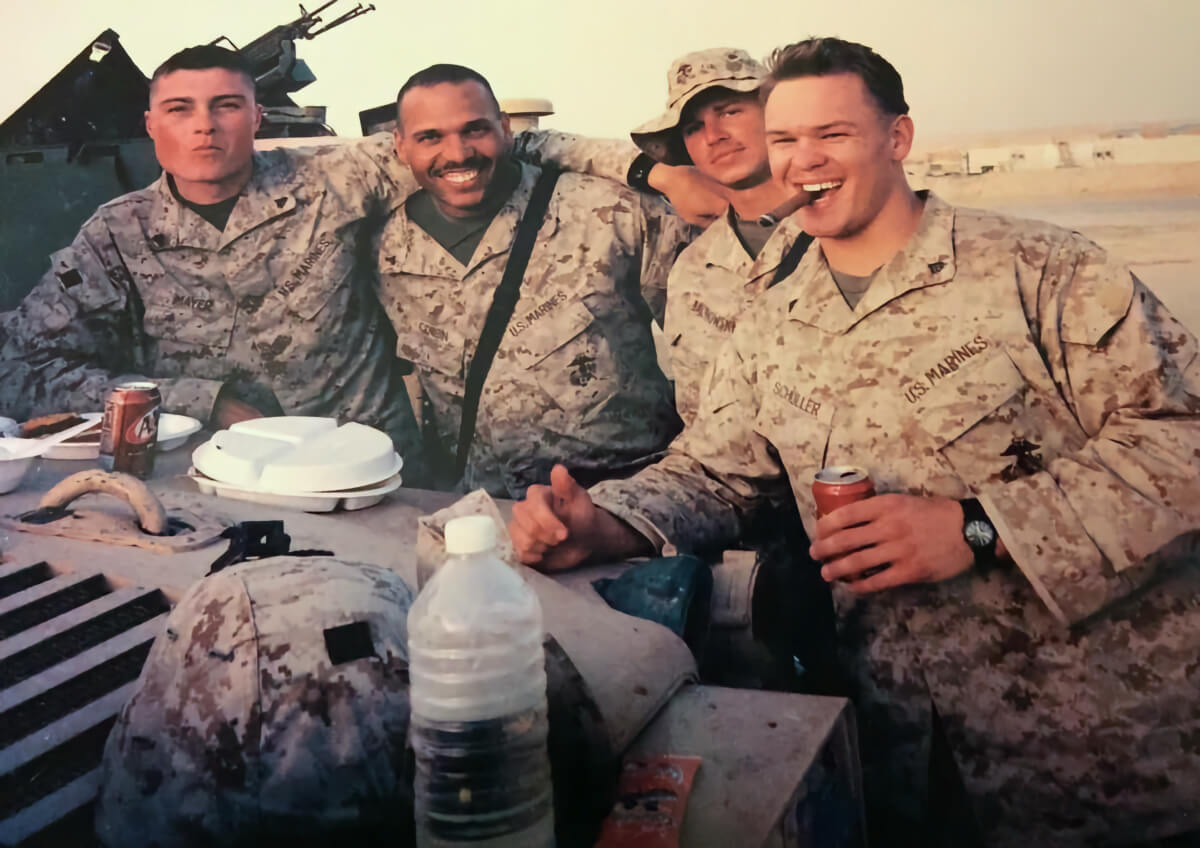
The Ohio boys. From left to right; Stan Mayer, Todd Corbin, Mark Kalinowski, Jeff Schuller. Courtesy of Stan Mayer
For the next few months, Watkins worked the platoon day and night.
“Mobile Assault Platoon 7 was not infantrymen, it was ‘every Marine a rifleman,’” remembered Mayer. “Watkins was not happy that he didn’t have infantrymen and he would be damned if he didn’t make us into the infantrymen he wanted. He treated that work up like a deployment. He would not let us sleep. There was not one minute he let go by that we weren’t learning. What that really did was it made the platoon have a special chemistry.”
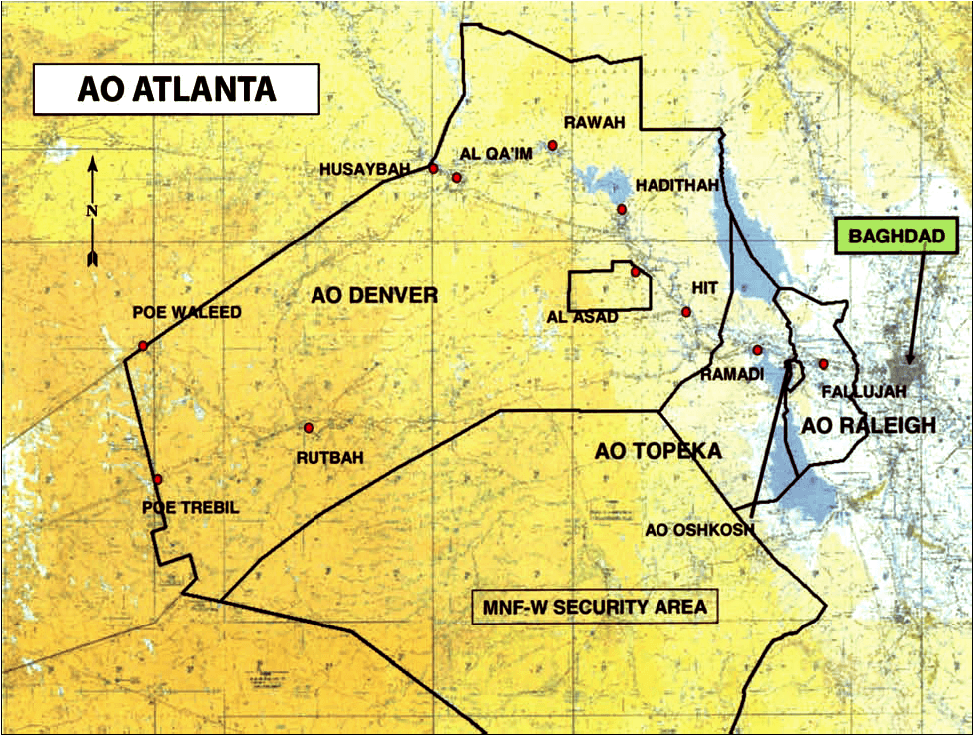
The battalion arrived in Iraq on Mar. 6, 2005, and drove to Haditha, 150 miles northwest of Baghdad. The Marines occupied the Haditha Dam, a massive, multi-level concrete structure situated across the Euphrates River. Other towns in Anbar Province such as Fallujah or Ramadi already gained notoriety since the 2003 invasion. Haditha had yet to cement its place in the history of the Iraq War.
MAP 7 fell into a repeating cycle. The platoon spent most days on the road conducting route reconnaissance, setting up observation posts, or ferrying the battalion commander around the AO. Periodically, the platoon received a scheduled day of rest. Despite the size of the dam, living space was cramped. Marines piled into dormitory-style rooms, some with balconies overlooking the river and the urban center of Haditha several miles south. They filled their off days cleaning weapons, tinkering with their trucks, and chain smoking cigarettes on the balcony while heckling sister platoons doing the same.
USMC History Division
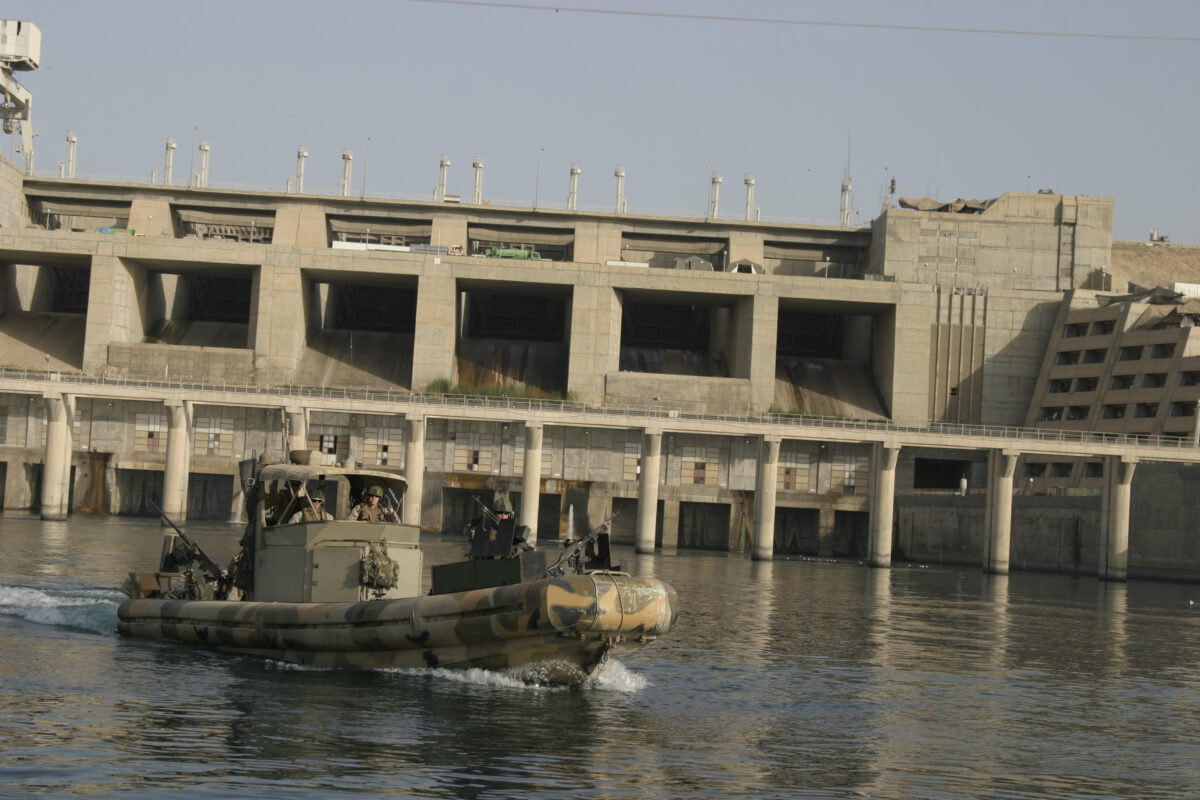
Riverine Marines conduct a boat patrol on the Euphrates River near Haditha Dam. Corporal Justin L Schaeffer, USMC
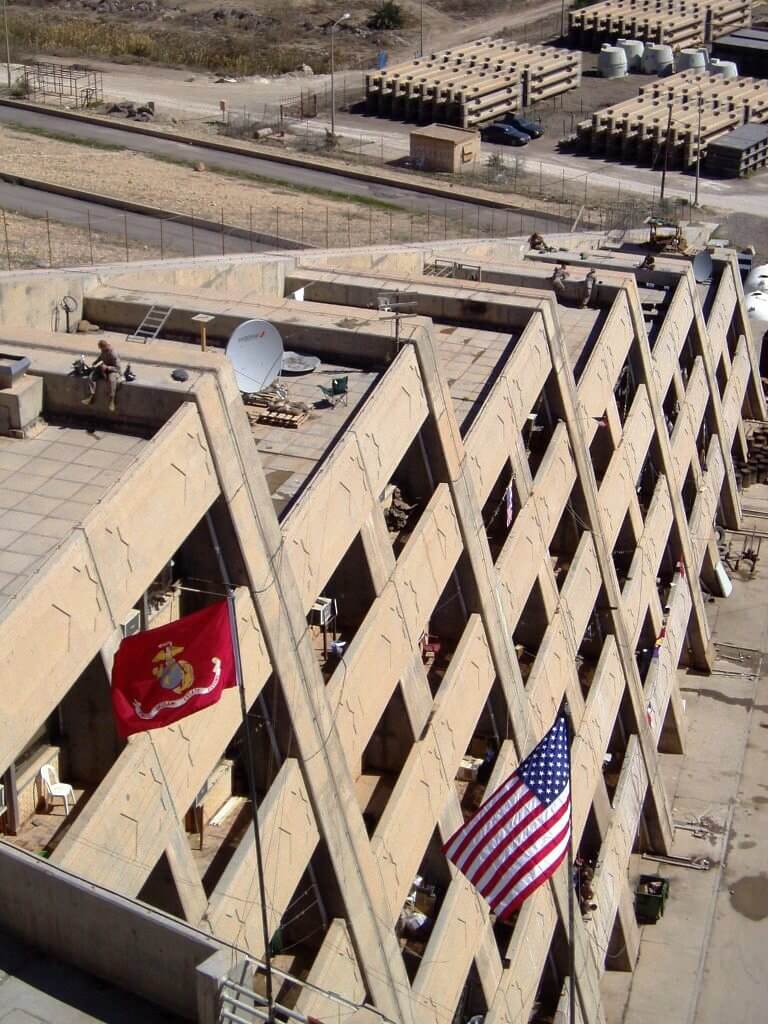
The exterior balconies of the living quarters at Haditha Dam. USMC Photo
When not on rest or a planned mission, MAPs took turns as the battalion Quick Reaction Force (QRF). The duty platoon stuck close to the dam, ready to deploy at a moment’s notice. If nothing bad happened, QRF days became another day of rest. Platoons could never relax, however, in the presence of the phone. Marine communicators strung telephone wire down the MAP hallway inside the dam, ending at a single, red telephone. Like the ubiquitous “bat phone,” the QRF phone existed for one purpose.
“It’s not like it was ever your mom calling,” said Jeff Schuller, today a major and active duty Infantry Officer. “It’s never good news. You’re just sitting there reading, watching stupid movies, trying to think about anything other than what you’re doing. That thing would ring and hearts would just drop. I don’t think I’ve ever hated an inanimate object in my life as much as I hated that phone.”
The phone rang a lot. Any time the battalion had troops in contact, the QRF deployed to assist. Any time a mortar round struck the dam, the QRF investigated the point of origin. Any time another platoon struck an Improvised Explosive Device (IED), the QRF deployed to recover the vehicle. By the time a tour of duty ended, platoons coming off QRF gleefully tossed the phone to the next in line like a hot potato.
MAP 7 suffered its first casualty less than two weeks into the deployment when a humvee in the column hit a landmine. The explosion severed the leg of LCpl Aaron Rice, seated inside the vehicle. The vehicle was destroyed, but thankfully, Rice survived. At the motor pool in Al Asad, the platoon sought another humvee as a replacement. The Motor Transport chief offered instead an up-armored, heavily modified 7-ton. The truck previously served a command vehicle. The gutted cargo area had new seating and tables installed. Marines welded pintle mounts around the exterior of the bed, enabling the addition of several machine guns. When fully outfitted, the truck bristled with gun barrels like an old WW II bomber. A 7-ton was a poor platform for casualty evacuations and the antithesis of “mobile” or “assault,” but the platoon would have to make it work. As one of the only Marines with a license to operate the vehicle, Todd Corbin volunteered to drive.
By the beginning of May, MAP 7 covered hundreds of miles around Anbar province. The platoon encountered IEDs and traded fire with the enemy in numerous encounters. Despite several close calls, Rice remained the only casualty. MAP 7 returned to the dam on May 6th to rest and refit once again following another 24 hour patrol.