

CHAPTER 2
The Mission
“Like in an old western, the rocking chair is rocking but no one is in it. You knew something was going to go down.”
— Stan Mayer
As the sun rose on May 7th, the exhausted Marines sipped coffee and tried to relax, waiting out the daylight hours. Again that night already, MAP 7 was scheduled to depart after dark to an overnight observation post. To make matters worse, QRF duty fell to them once again for the day. A significant portion of the battalion deployed west toward the Syrian border in preparation for Operation Matador, a major offensive scheduled to begin the next day. MAP 7 remained in the rear with a skeleton crew at the dam.
Mark Kalinowski sought out Schuller in his room first thing that morning and hounded him to get their truck down to the motor pool. Earlier that week, Schuller spotted brand new humvee turrets, boxed up and waiting to be installed. Kalinowski adamantly wanted the upgrade. As the vehicle gunner standing exposed above the roof, his life depended on it. A cylindrical metal shield formed his current turret, like a large barrel cut in half, offering meager protection. The upgraded turrets were constructed of true armor plating, spaced and angled for maximum protection. Schuller chaffed at the idea, wanting instead to relax for the remainder of his day at the dam, but eventually he capitulated. The two spent the next four hours constructing and installing the upgrade. Kalinowski mounted his M240G machine gun and tested the turret’s operation. When traversing the gun left or right, only a small 3 inch gap opened on either side of the armor plate in front of him. The surrounding armor felt significantly better than his previous accommodations. The true level of protection, however, would only be revealed in combat.
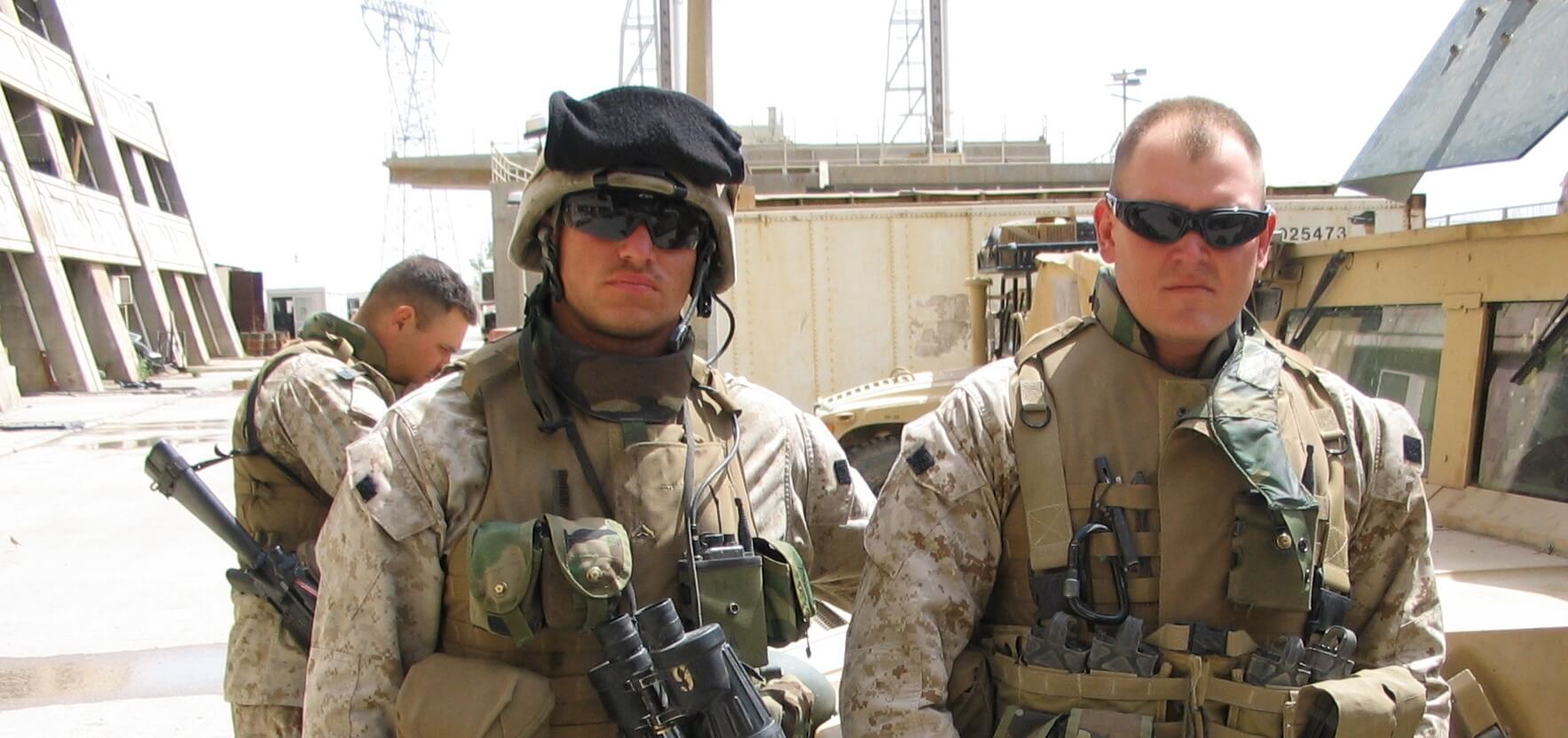
LCpl Mark Kalinowski, left, and LCpl Lance Graham, right, in Iraq in 2005. Courtesy of Stan Mayer
The Marines prepared for their overnight mission as the sun dipped in the western sky. Watkins sat with Cepeda in an internet cafe penning digital Mother’s Day cards to send home. A dull “boom” suddenly thudded outside. Watkins immediately recognized it as an enemy mortar striking the dam. He ordered Cepeda down to the rest of the platoon to start getting ready to roll out. Watkins made his way to the Combat Operations Center (COC) to find out what they knew. Deep inside the dam, the QRF phone rang to life.
The platoon assembled with their vehicles at the gate leading out the east side of the dam. Insurgents routinely fired mortars from the eastern side of the Euphrates then fled into the open desert. Tonight, however, the COC instructed Watkins to turn his column around and stage at the west gate. This mortar attack originated in Haditha on the western bank. Watkins sensed something off. This was a new tactic. The COC ordered Watkins to stand by and wait for a pair of tanks to support his column.
While MAP 7 waited, machine gun fire echoed to the south. Word spread of a sister platoon several miles down river on the eastern bank taking fire from a palm grove in Haditha on the western bank. Marines in riverine patrol boats sped down river from the dam and blasted the palm grove with machine guns and automatic grenade launchers. Each time the enemy fire ceased and the boats departed, mortars soon resumed firing toward the dam and insurgents shot at the MAP on the eastern side.
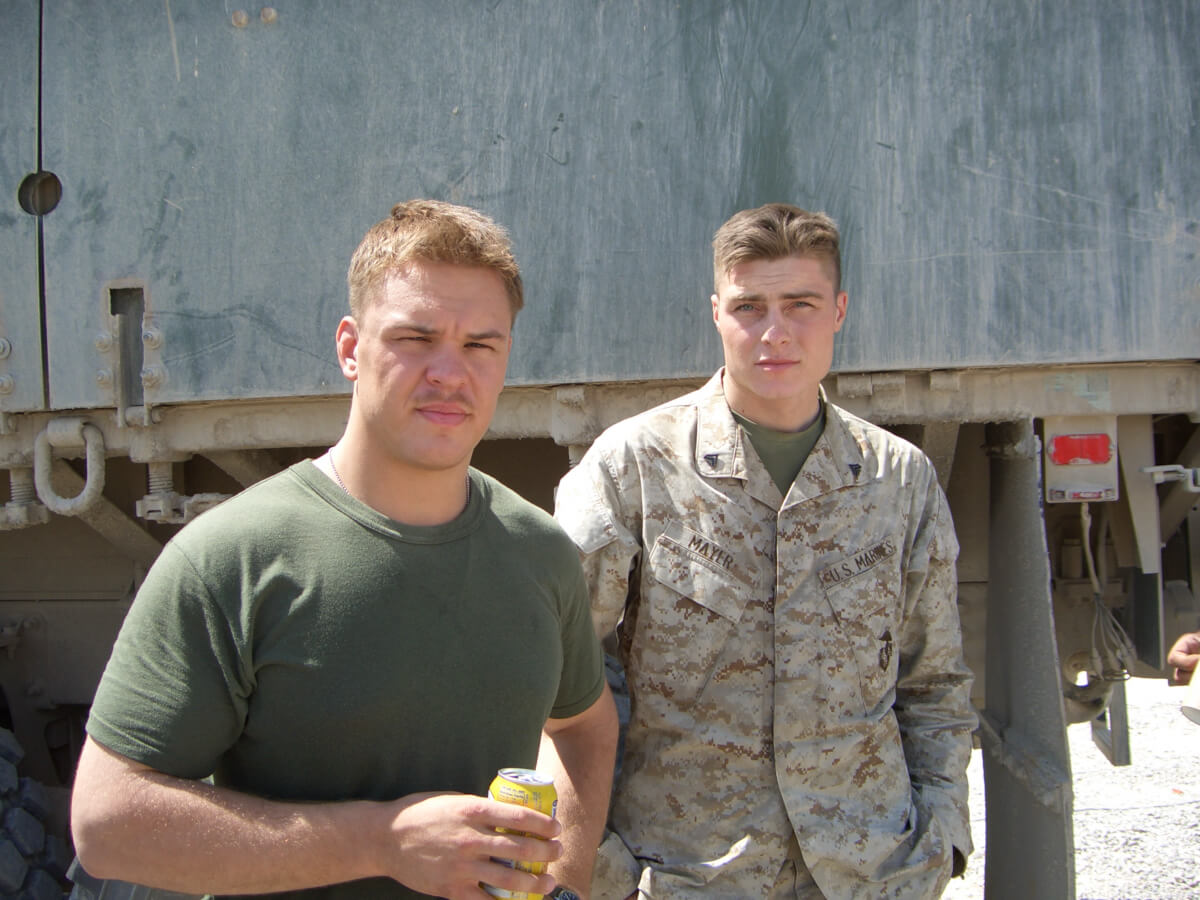
Cpl Jeff Schuller, left, and Cpl Stan Mayer, right, in Iraq in 2005. Today, Schuller is a major and an infantry officer on active duty. Mayer eventually left the Marines and became an intelligence officer with the Defense Intelligence Agency. In 2022, he wrote a play titled, “Mama Mama Can’t You See,” produced in Hollywood and based on his experience in the May 7th ambush. Courtesy of Stan Mayer
“We heard the radio traffic start coming through and I was thinking why would someone with an AK-47 start shooting at a gun truck with a machine gun on top?” Watkins said. “It’s suicide. This was obviously something we had never seen before.”
The platoon waited nearly two hours for the tank support to arrive. Despite their frustration over the delay, the Marines’ spirits remained high. Mayer was certain tonight would finally be their opportunity to take the fight to the enemy. The sentiment spread. Two Marines from outside the platoon joined at the last minute, a staff sergeant from the armory and a cook eager for his first chance to leave the wire.
Darkness enveloped the dam by the time the tanks arrived. Mayer fired up his humvee. Watkins sat in the vehicle commander seat next to him. One by one, the three humvees of MAP 7 fell in behind the first tank and surged out the gate. Corbin drove his 7-ton in the middle of the line with the last tank bringing up the rear. The palm grove lay only 15 minutes away in the heart of Haditha.
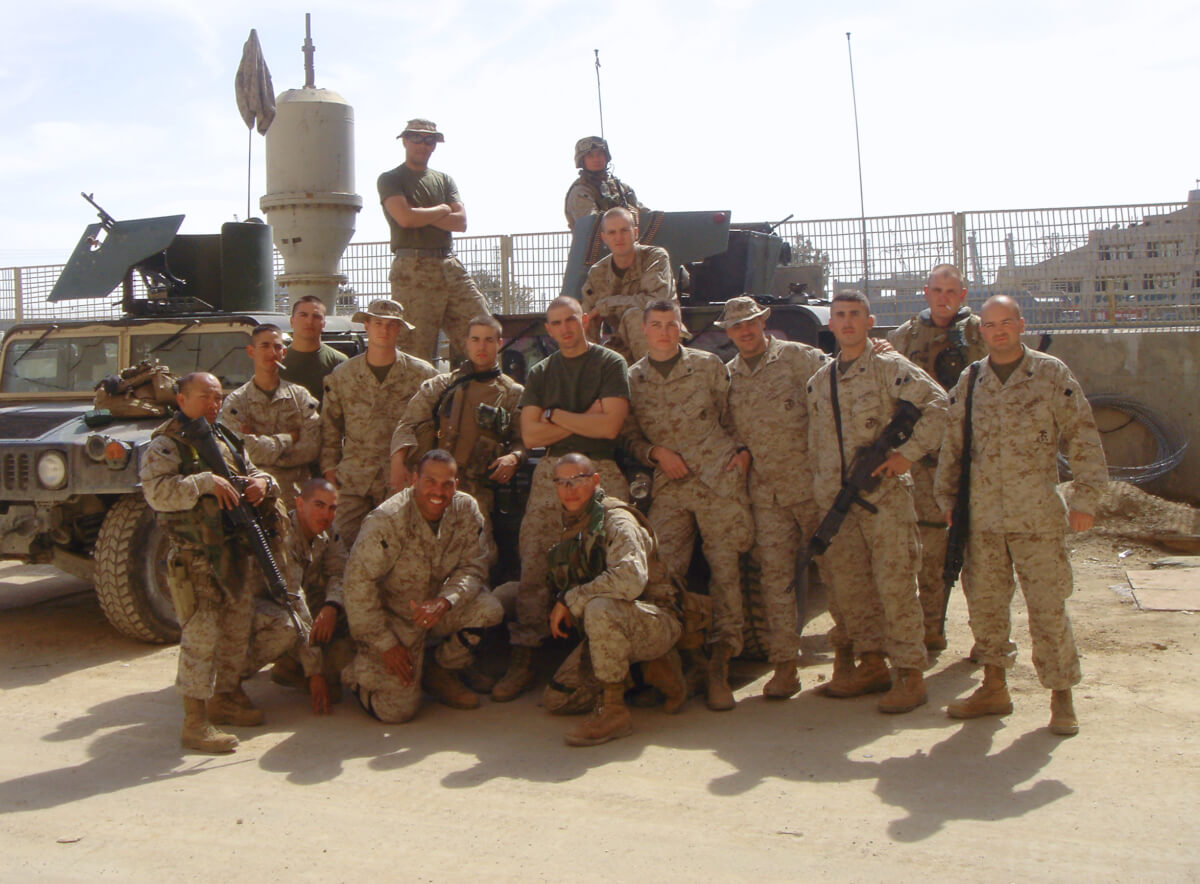
A group photo of MAP 7 early in their deployment. On top of humvee in background: LCpl Lucas Hall (left), LCpl Mark Kalinowski (right), Cpl Robert “Zane” Childress (kneeling). Standing, left to right: Doc Vang, replaced by HM3 Jeffery Wiener (KIA) soon after this photo was taken, LCpl Steven Wilfong, LCpl Jose Gonzales, LCpl Justin Henderson, LCpl Aaron Rice, Sgt Randall Watkins, Cpl Stan Mayer, Sgt Michael Marzano (KIA), Sgt Aaron Cepeda (KIA), LCpl Lance Graham (KIA), Sgt Ryan Pace. Kneeling in front, left to right: Cpl Adrian Garza, LCpl Todd Corbin, LCpl Rando Idiaquez. Not pictured: SSgt Michael Brady, HM3 Jeffery Wiener, Cpl Jeff Schuller. Courtesy of Randall Watkins
The column drove south paralleling the river. Mayer followed the tank ahead through his night vision goggles. He passed a single vehicle on the side of the road with hazard lights flashing at the city line, but no one else appeared anywhere in sight. On the radio, their sister MAP reported the enemy broke contact and disappeared. Haditha fell silent.
Watkins tracked the column’s position on his global positioning system. It lagged and failed to provide him a real-time position as they crossed into the city. By the time it finally updated, Watkins realized they passed their objective in the darkness. He halted the column. Their only option now was to turn around, and to do it as quickly as possible. Six-foot walls lined the street on either side of the road. Street lamps dimly illuminated the Haditha hospital rising above the wall on their left, with narrow alleyways disappearing into the darkness down either side of the compound. It was a bad spot, and everyone seemed to know it. Chatter over the internal radios ceased.
“It was night so no one really should have been around, but I mean no one was around,” Mayer remembered. “Like in an old western, the rocking chair is rocking but no one is in it. You knew something was going to go down.”
The tanks covered the road to the south as Marines dismounted and the convoy reversed direction. Even the smaller humvees required multi-point turns to spin in the street and point north once again.
Watkins dismounted to provide security and guide his humvee through the dark. He glanced at Mayer before exiting the vehicle.
“I’m gonna go run the rabbit and draw some fire.”
An ambush felt imminent. Watkins figured he would trigger it by exiting the vehicle. With Graham in the turret above watching over him, he remained confident. He reached back and elbowed the shin of Graham, who stood behind him.
“Let’s go get some.”