

CHAPTER 3
The Ambush
Mayer weaved his way around and back through the rest of the vehicles. He parked near the intersection at the corner of the hospital, covering the rear of the column. Behind him, the rest of the platoon began turning around.
“I wanted to get into a good spot for Graham to cover us with his machine gun,” Mayer said. “I was asking him, ‘Is this good? How about this Lance?’ All of the sudden, I heard Lance screaming, ‘Stop mother fucker! Stop!’ I thought he was screaming at me so I stopped. I thought we had somehow rolled onto an IED he saw that I didn’t. The last thing I heard was Lance spinning the turret, racking his machine gun, and just beginning to open fire when an eruption occurred that was just like a hard reset.”
Unseen by Mayer, a suicide bomber in a van packed with explosives emerged from the darkness, careening down the alley. The van plowed into a wall near Mayer’s humvee and detonated. The awful blast leveled walls and buildings around the intersection. An impenetrable dust cloud covered the area and a ball of fire exploded upward like the sun rising over the Euphrates.
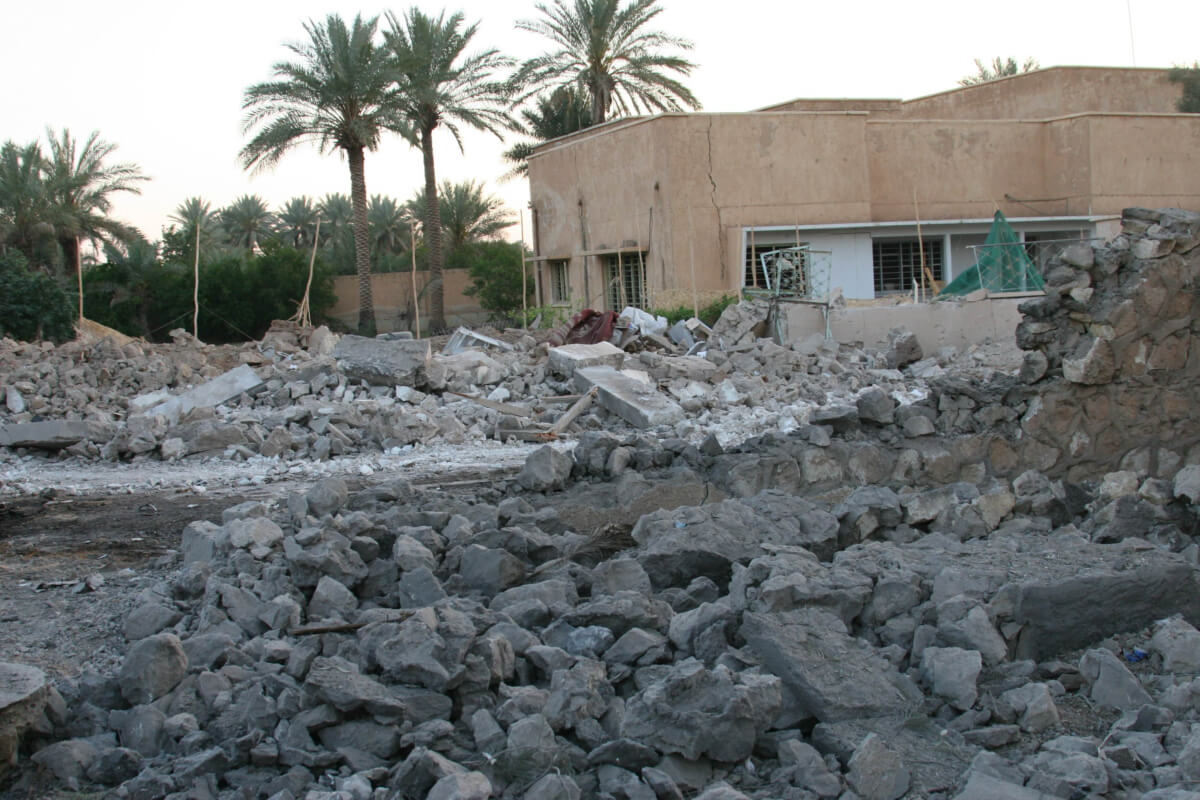
The street where the suicide bomber detonated, pictured the morning of May 8. 2005. The buildings lay in ruins from the blast. USMC Photo
In his humvee a few dozen meters away, Schuller had just completed his turn. He found an unmolested patch of concrete and drove off the road on top of it. No insurgent, he thought, would go through the effort of pouring fresh concrete over a planted IED. When the suicide bomber detonated, all four wheels of Schuller’s vehicle lifted off the ground. Schuller was dumbfounded and angry, believing he had in fact parked directly over an IED. Behind him, Kalinowski slumped down beneath the turret. A chunk of shrapnel flew through the gap beside his machine gun and obliterated his wrist. Schuller crawled through the cab closing all the doors that hung open. Gunfire and screaming filled the air. Schuller took Kalinowski’s place in the turret. Outside, dead or wounded Marines littered the street. The remaining hulk of Mayer and Watkins’ humvee glowed a fiery orange through the dust cloud. Muzzle flashes illuminated the hazy outlines of sandbagged positions across the roof line of the hospital. Without hesitation, Schuller spun the turret and opened fire. He poured an unending stream of lead into the building as rounds pinged off the metal around him. The upgraded turret might now save his life rather than Kalinowski’s.
When the blast pressure passed over, Mayer convinced himself that he was not dead. He couldn’t hear. He could barely see or feel. He reached out from inside himself, working through a mental checklist to rediscover each body part and assess whether it still functioned. He felt pain. His entire body felt flash-fried, like the worst sunburn one could possibly endure. He found his door blown open and lifted himself out of the vehicle. He turned back towards his seat. The ruined humvee sat low on four flat tires with the roof line at chest height. Ricocheting bullets sparkled brightly off the metal top without a sound. Confounded, Mayer gazed upward towards the hospital. The building disappeared, veiled in dust. Hovering muzzle flashes twinkled in the air, bedazzling the dirty sky.
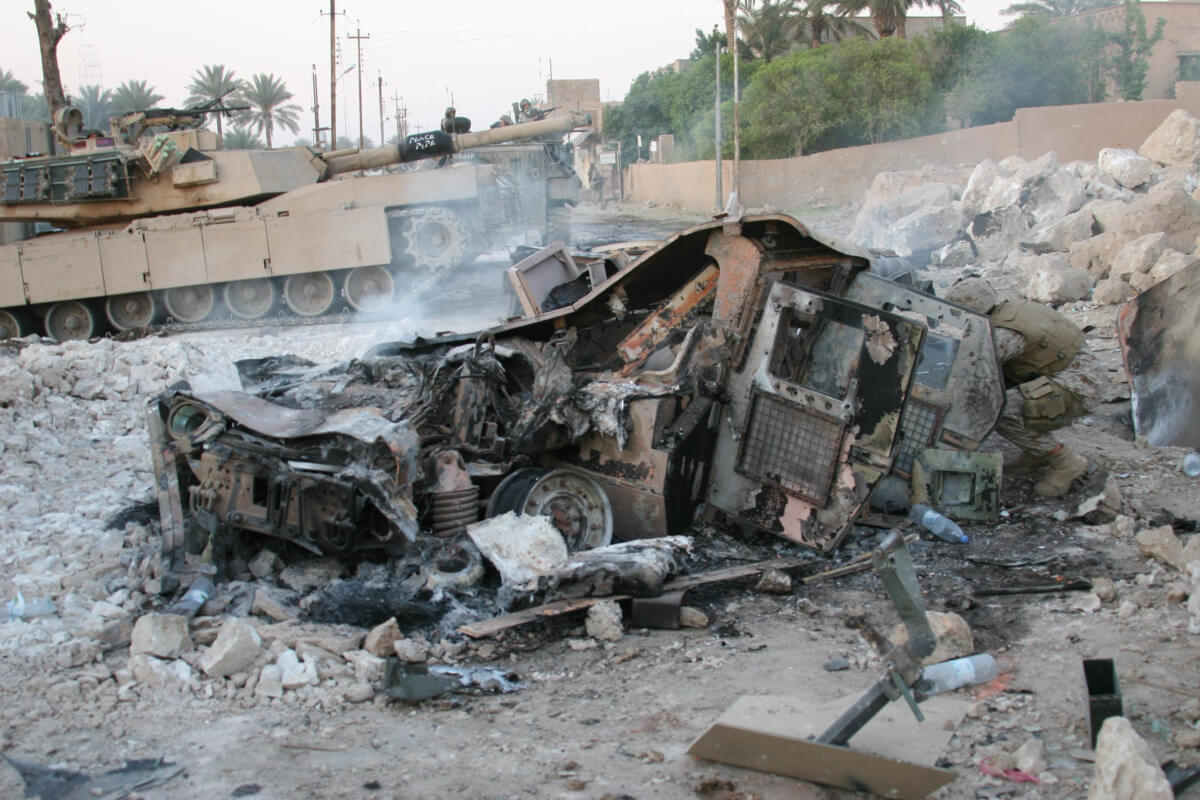
On the morning of May 8, Marines returned to Haditha to recover the vehicles destroyed in the previous night’s ambush. Pictured here are the remains of the lead humvee occupied by Stan Mayer, Lance Graham, and Randall Watkins. USMC Photo
Amidst the sparkling rounds, a perfectly flat surface stretched out in front of Mayer where the armored turret had once sat. Fire licked up through the hole where the gunner once stood. Where was Graham? The question zapped Mayer back to reality.
“I dropped to the ground and scrambled around on my knees until I found my rifle which had been blown out of the truck,” he said. “I racked a round into the chamber then sat there and took cover. I guess I was waiting for somebody in charge to tell me it’s ok to shoot my rifle because I’d never shot it without a Marine telling me to. I just sat there listening to the rounds slap against the humvee until I realized this was not the rifle range. So I stood up, aimed at the muzzle flash, and pulled the trigger until it went away. After that moment, everything became less ethereal. Everything was all just like a dream state until I had that realization that this was combat.”
Dismounted and standing nearby, Watkins absorbed shrapnel across his body. Enemy gunfire followed the explosion. Two rounds struck the plate in Watkins’ body armor and one punched through his shoulder in the same area where a large piece of metal tore through moments before. The resulting wounds looked like someone dug out his left breast with an ice cream scoop.
“I went down and I couldn’t move,” Watkins recalled. “There was rubble everywhere. I could hear people screaming. I couldn’t feel my left arm or my left leg, but I still had my rifle in my hand. I emptied the magazine but couldn’t reload another. Rounds were impacting in the street all around and I could see muzzle flashes on both sides of the street. I basically just laid there waiting for a bullet to hit me in the head. I tried to yell, but nothing was coming out. Across the street, I watched Childress go down, but get right back up and go to a Marine who was screaming in pain.”
Todd Corbin materialized through the dust cloud, standing over Watkins. He heaved the grievously wounded sergeant over his shoulder and ran back to the 7-ton. As he loaded Watkins in the bed, a tank next to them fired a main gun round into another vehicle approaching the ambush site. Concussion waves swept over the Marines in the back as they dragged Watkins to the front of the bed. Outside, Corbin found Childress leaning over a Marine with the muscles shorn from the back of both legs and femurs exposed. In the darkness and rubble-strewn chaos, Childress inadvertently looped a downed power line inside a tourniquet placed on the Marine’s leg. The line snagged and went taut as Childress and Corbin dragged him away. They freed the line, replaced the tourniquet, then placed the Marine in the 7-ton with Watkins.
“I went down and I couldn’t move. There was rubble everywhere. I could hear people screaming. I couldn’t feel my left arm or my left leg, but I still had my rifle in my hand. I emptied the magazine but couldn’t reload another. Rounds were impacting in the street all around and I could see muzzle flashes on both sides of the street. I basically just laid there waiting for a bullet to hit me in the head.
— Randall Watkins
The cook who joined the mission at the last minute stumbled out of the back seat of Mayer and Watkins’ humvee. He found Graham lying motionless nearby beneath a pile of building rubble and twisted turret armor. Mayer tried to move Graham’s body but was unable to pick him up. Mayer told the cook to stay put and set out in search of the remainder of the platoon. He ran through a cloud of smoke and dust to where the other vehicles sat mixed together on the street.
“The scene that I saw in front of me was so stunning,” he remembered. “All the humvees were destroyed, the 7-ton was billowing smoke, pools of oil on the ground had caught fire, power lines were on the ground, there were bodies and casualties lying around, there was Jeff on the turret in the background just yanking back on the trigger of his 240; it was like a scene from a movie. It was total apocalyptic chaos.”
Mayer came across a Marine leaning over Hospital Corpsman 3rd Class Jeffery Wiener, the Navy Corpsman assigned to MAP 7. Mayer prepared a tourniquet and checked the doc for wounds, but found no external bleeding. The blast pressure alone produced significant internal damage. Wiener passed away as Mayer swept across his back side checking for injuries.
Mayer continued on, finding Corbin standing outside his 7-ton.
“When I got up to Todd, I must have been screaming at him,” Mayer said. “I couldn’t hear shit, my ear drums were melted, I had just found Lance’s body, Doc just died in my arms, I ran past another body that I couldn’t even tell who it was. I ran up to Todd and grabbed him and just started screaming some sort of gibberish at him. He was just like, ‘you need to calm down son.’ He’s a lance corporal, 30-something-year-old sheriff deputy, just lawless. You could not get him to do anything he didn’t want to do. I love him, he’s my brother for life, but when he told me to calm down I wanted to fucking kill him.”
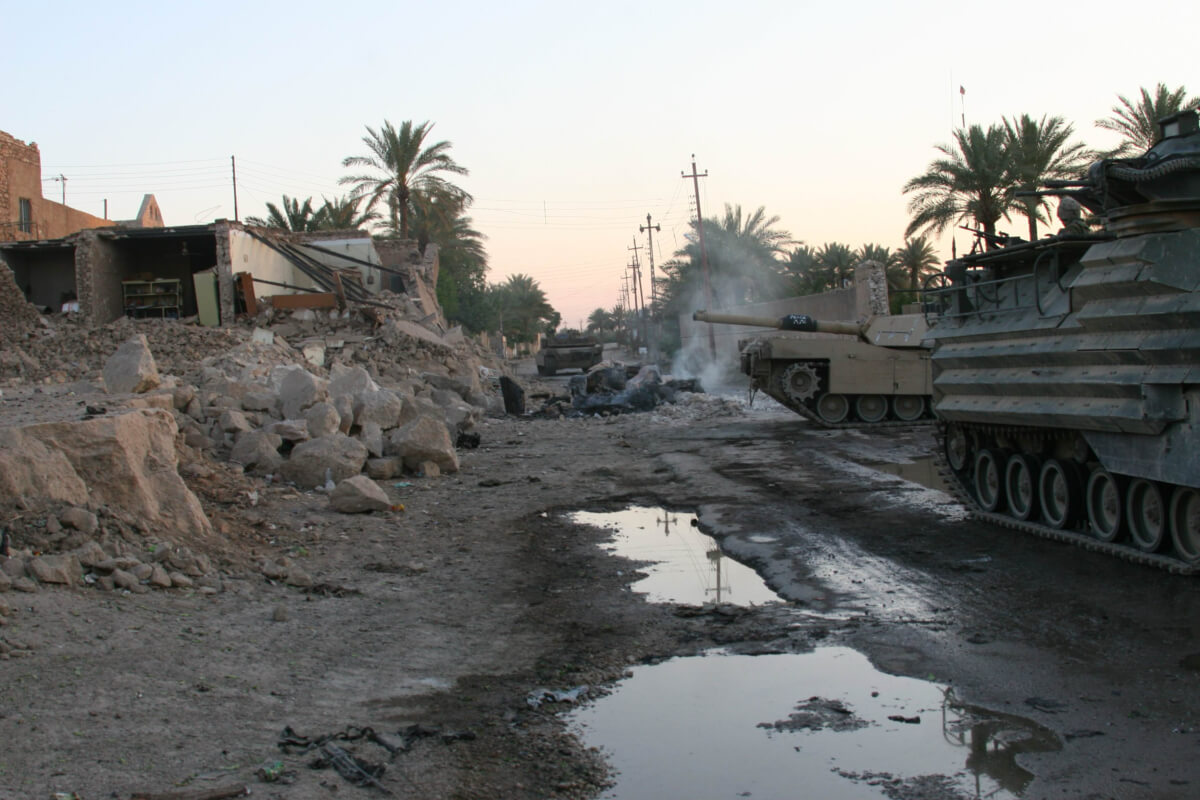
The street where MAP 7 fought for their lives on the night of May 7, picutured the following morning. USMC Photo
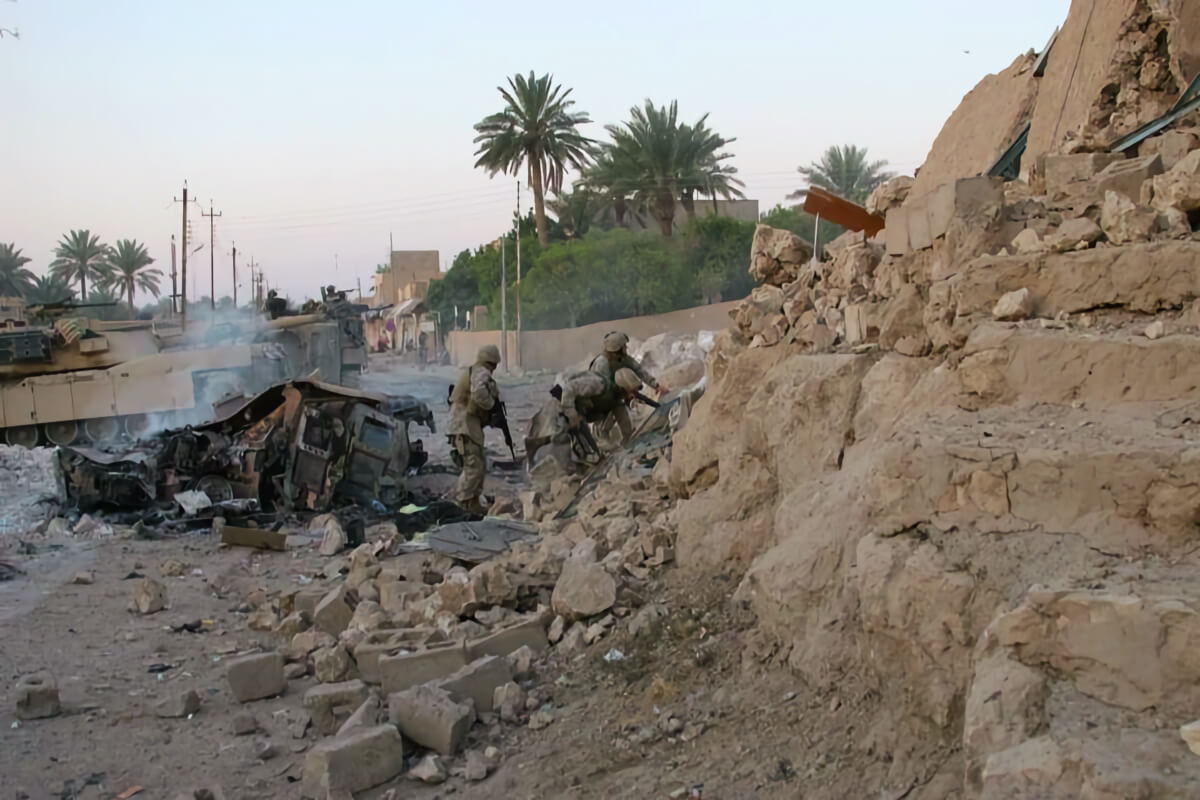
Marines search the ambush site on the morning of May 8th around the remains of the humvee occupied by Mayer, Graham, and Watkins the night before. USMC Photo
The pair set out together collecting more casualties. Mayer fired at muzzle flashes in the dark while Corbin focused on moving the dead and wounded. They first returned to the body Mayer earlier passed, later identified as Sgt Marzano. They brought him to the 7-ton and went back for Doc Wiener. At one point, Mayer passed close by the humvee where Schuller stood protecting the entire column with his machine gun.
“I was completely black, charred and covered in dirt,” Mayer remembered. “I looked like I just stuck my finger in an electrical socket powered by an atom bomb. When Jeff saw me, he yelled, ‘what are you doing here?’ I shouted back, ‘what the hell do you mean?’ He says, ‘where is the chaplain at?’ The whole time we’re having this conversation he is continuously firing the 240 into the hospital. I realized he didn’t recognize me. I was like, ‘what the fuck are you talking about? It’s me! Stan!’ After a second he giggles and goes, ‘oh shit! I thought you were dead! Awesome buddy!’ We had a Marine who was the assistant to the battalion chaplain and he was black. Jeff saw me and thought that the chaplain came out and I was his assistant. He thought I was dead. He knew I was dead. It made more sense to him that I was the black Religious Program specialist than his best friend Stan.”
Schuller stood exposed continuously in the turret. Beyond the rifle fire from Mayer, Childress, and a few others still standing, Schuller’s machine gun stood alone as the sole weapon keeping the enemy ambush at bay. He burned through several hundred rounds in rapid succession. Every time an ammo can ran dry, Kalinowski readied and passed up another from inside the humvee. Whenever they paused to reload, Kalinowski handed him an M16 to keep up the return fire. The muzzle flashes morphed into visible insurgents on the street.
“I shot one guy with the 240 standing in the front doorway of the hospital only 20 or 30 meters away,” Schuller said. “It was very obvious that guy was dead in this life and the next. I vividly remember thinking, ‘oh wow, this machine gun works,’ like it was an epiphany. Kind of like the first time I ever jumped out of an airplane and the chute opened, I remember yelling out, ‘wow! I can’t believe it worked!’”
The gun kept working. Enemy fire broke under Schuller’s relentless barrage. Still, rounds struck the humvee all around Schuller and kicked up dirt in the street around Corbin and Mayer as they recovered casualties. At one point as Mayer worked on a casualty next to Schuller’s humvee, an insurgent appeared in the window directly behind him.
“Get down!” Schuller screamed.
He opened fire just a few feet over Mayer’s head, cutting down the enemy soldier.
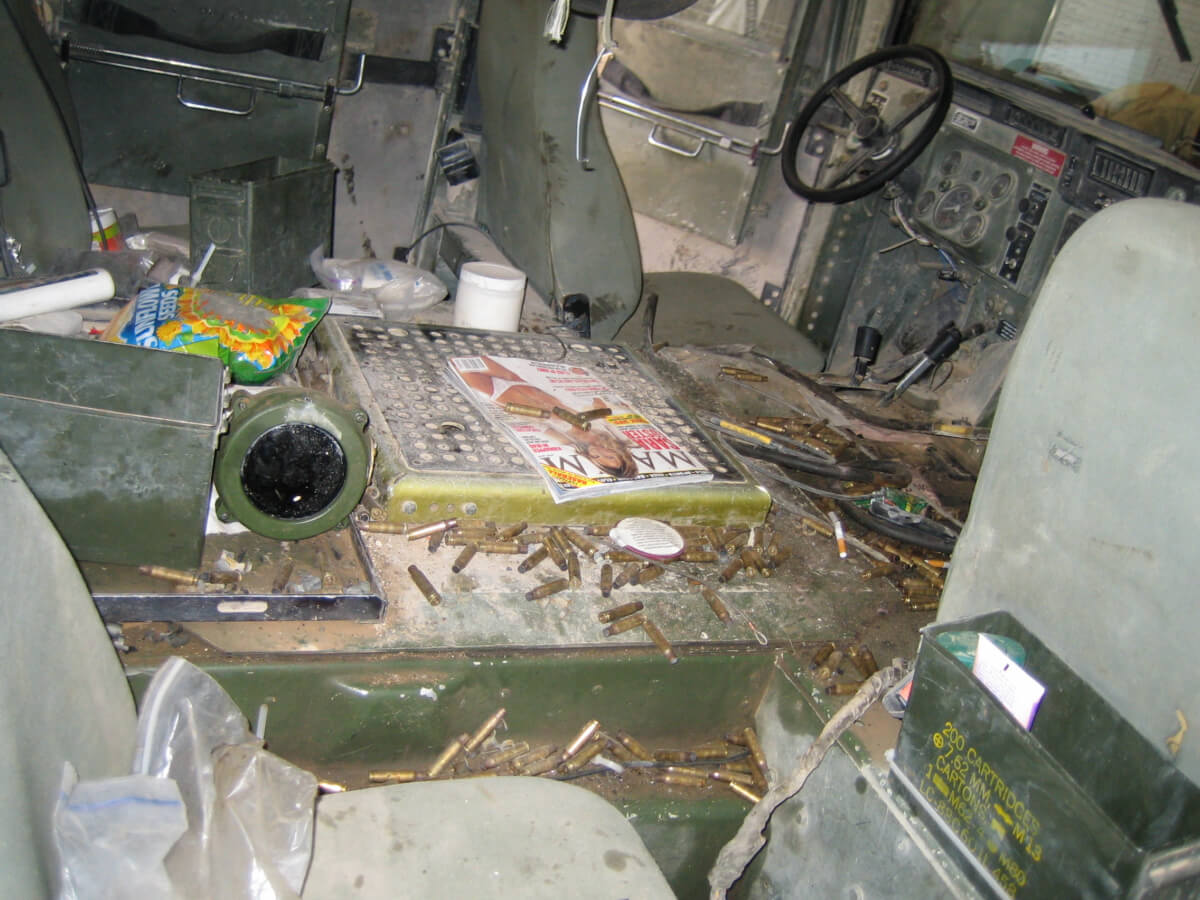
A view inside the humvee where Mark Kalinowski fed can after can of ammo to Jeff Schuller as he stood in the turret above suppressing the enemy ambush. The vehicle was immobilized by the initiating explosion. Courtesy of Randall Watkins
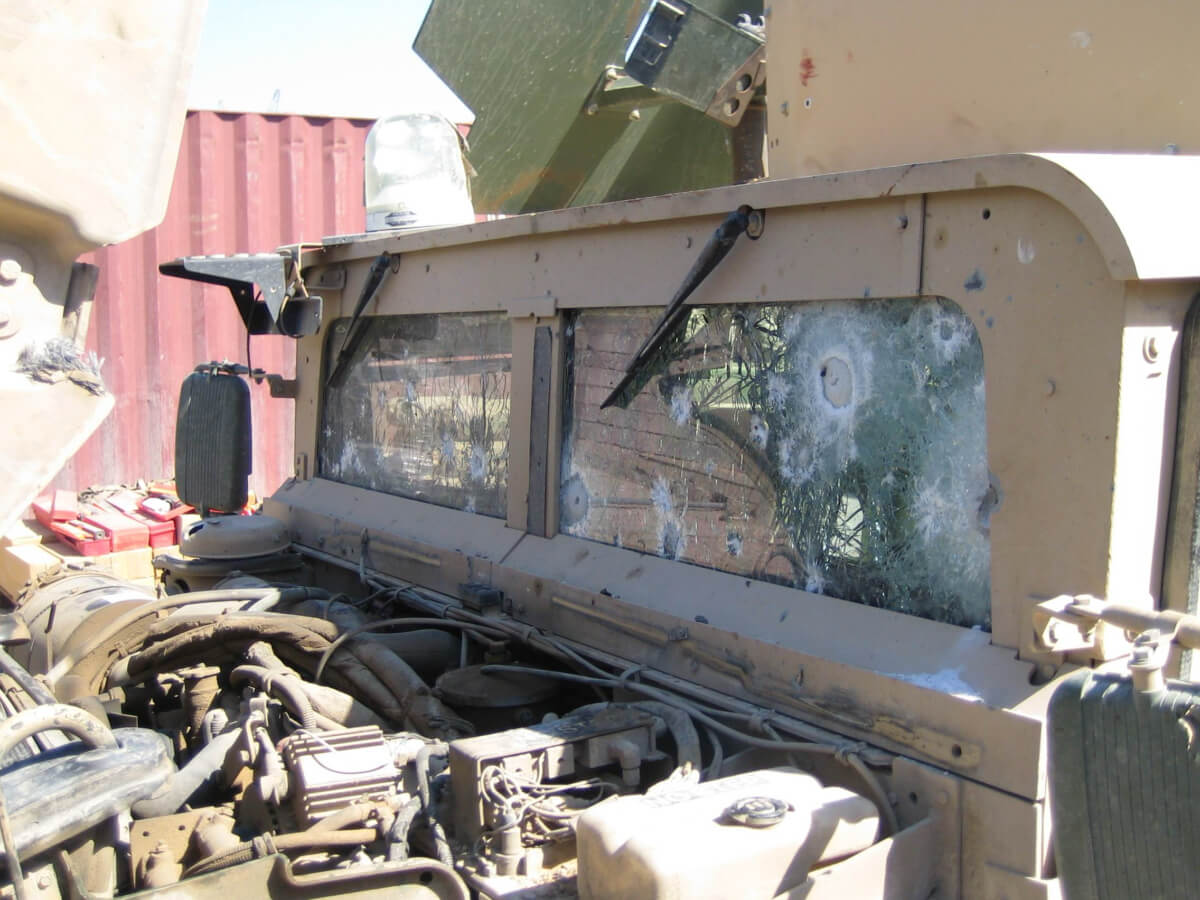
A view of the outside of Schuller and Kalinowski's humvee in the aftermath of the ambush. Courtesy of Randall Watkins
For nearly 45 minutes, Corbin and Mayer sprinted around the ambush site filling the 7-ton with dead and wounded. Childress assisted while zeroing out the radios and sensitive equipment in each vehicle and recovering weapons and gear. Schuller burned through more than 1500 rounds. When the machine gun ammo ran dry, he resorted solely to his M16. When that ammo ran out, he pulled his pistol, dropping at least one insurgent on the street.
Throughout the engagement, Mayer remained focused on getting back to Graham. The humvee burned and exploded over and over again with rounds cooking off inside as Mayer worked with Corbin to rescue other Marines. At one point, a tanker told Mayer to get one of the humvees out of his way so the tank could move into position and lead them out of the area. The destroyed vehicle was barely operational, but Mayer lurched it forward against a wall. When he stepped out of the driver’s seat, he found Aaron Cepeda’s body lying next to the humvee. Childress arrived and helped recover Cepeda’s body. Like Mayer, at some point through the ambush, Childress attempted to pull Graham from his location near the burning humvee. Already wounded with shrapnel across his face, neck, and right side, a bullet tore through his left leg as Childress leaned over Graham. By the time all remaining dead or wounded were loaded into the 7-ton, recovering Graham seemed nearly impossible.
Schuller and Kalinowski finally abandoned their humvee and loaded into the 7-ton. Corbin hopped back in the driver’s seat. He activated an emergency air compressor to keep the tires inflated enough to limp the 7-ton out of the kill zone. Another quick reaction force speeding south from the dam entered Haditha less than 1000 meters away. Mayer begged Corbin to stop for one final attempt to recover Graham. With numerous wounded aboard, including one Marine with tourniquets on both legs and Watkins bleeding out through a gaping hole in his chest, the Marines pressed on. They passed their rescue column on the way out of Haditha and pinpointed Graham’s location at the ambush site. The relief force fought their way into the ambush site and recovered his body. The three destroyed humvees remained.
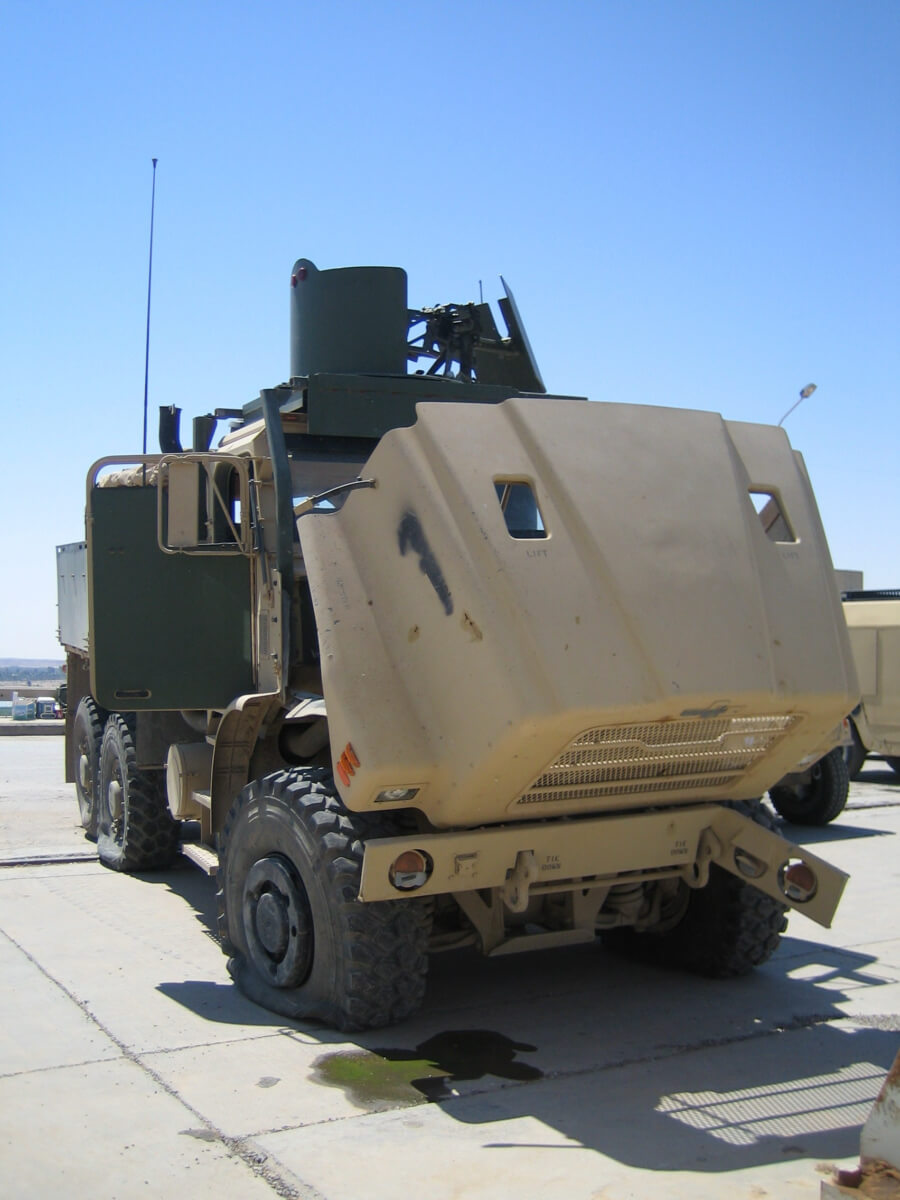
This 7-ton truck became the casualty evacuation platform for the entire platoon after MAP 7 was caught in the ambush on May 7th. Behind the wheel, Todd Corbin limped the vehicle away from the ambush site on flat tires and bleeding pools of fluids. Courtesy of Randall Watkins
When the 7-ton stopped inside the dam, a sea of Marines enveloped the bed. Of 16 Marines on the patrol, 11 were wounded or killed. Rescuers threw Mayer and Kalinowski onto the same medevac chopper. A zipped body bag lay near their feet. Neither knew who it contained, or who else may have died. Until that moment, both believed each other perished in the ambush. They arrived at Charlie Surgical in Al Asad where staff members efficiently stripped the Marines and checked them for holes. With additional wounded already arrived and more incoming, all hands stood on deck. They lined the hallways, heads swiveling and mouths agape as Mayer and Kalinowski rolled past. Mayer noticed two nurses weeping in each other’s arms. He looked toward Kalinowski.
“What the hell are they crying about?”
“I think us buddy.”