

CHAPTER 4
The Symbol
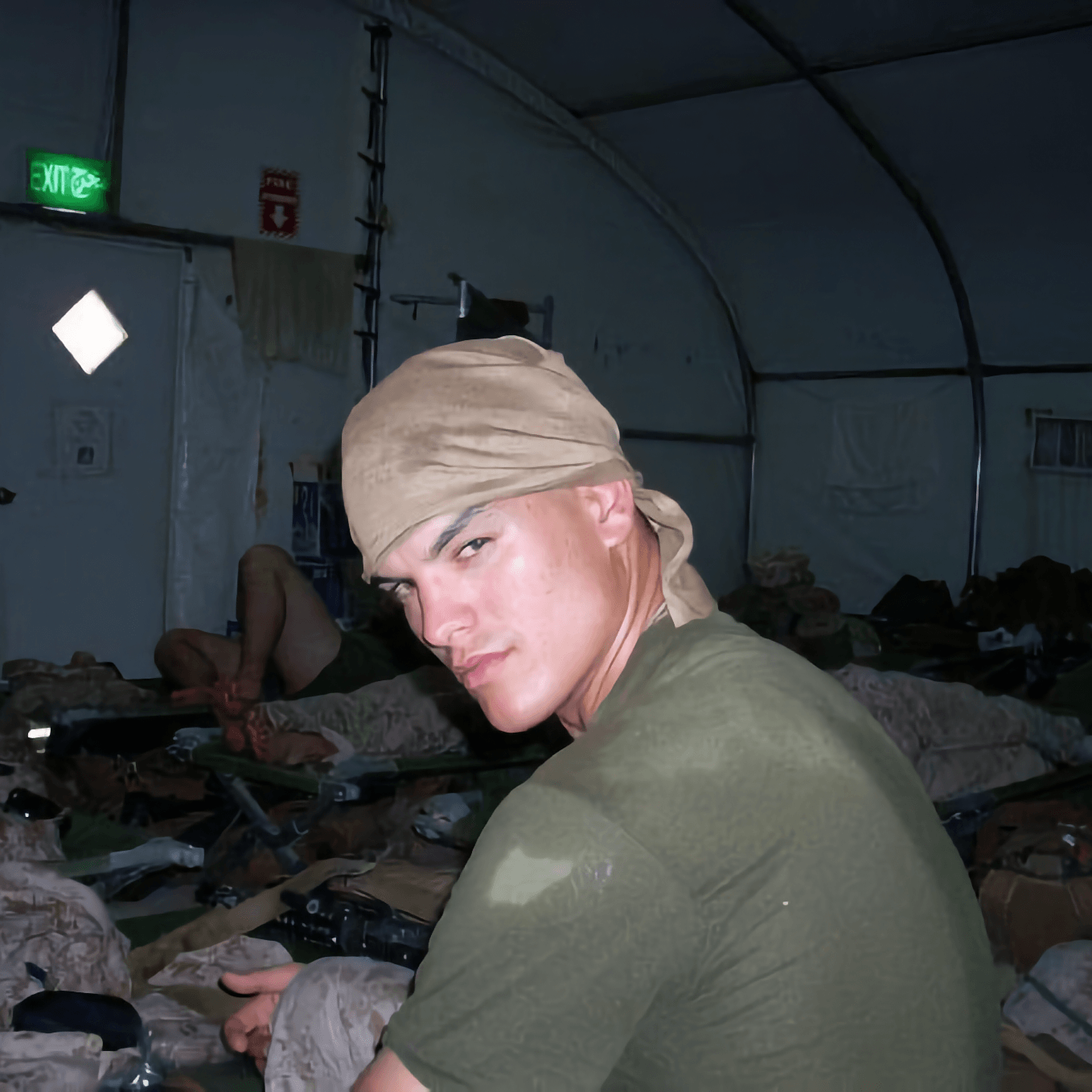
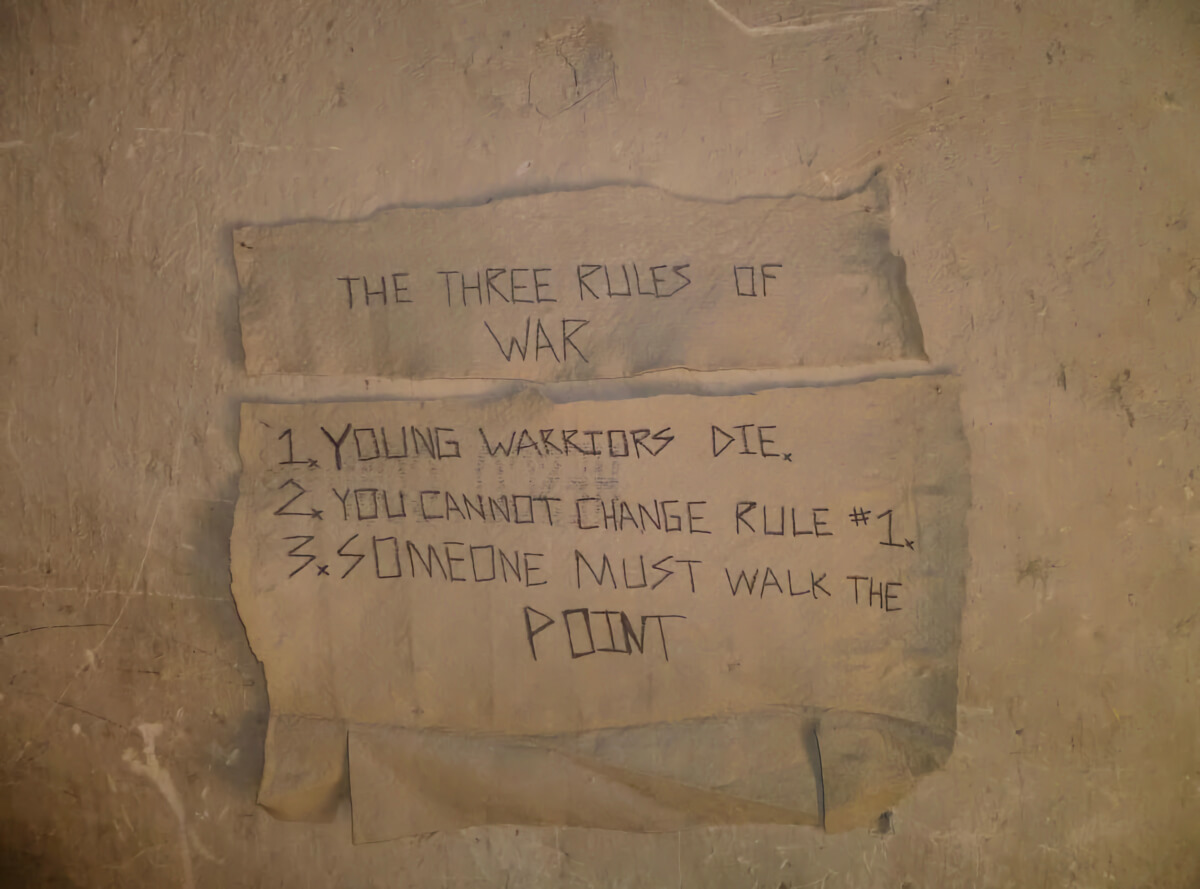
Jake: Throughout the deployment, Matt was really big on symbols. We had a wall where we carved stick figures for all the enemy we killed, or even buildings we destroyed in air strikes. Matt encouraged it because he wanted people to know what we were doing. He wanted us to know that we were making a difference, and whenever we would leave, he wanted them to know that we made a difference. The gunfighting commandments and rules of war were his own creation. To me, they were reflective of his personality.
Matt was a really over the top guy. His favorite movies were ‘80s and ‘90s action flicks. He just thought they were awesome. When he showed us the gunfighting commandments, he thought it was hilarious, but he also thought it was badass. I think for Matt it was a way to make light, but also be serious.
Courtesy of PB Abbate
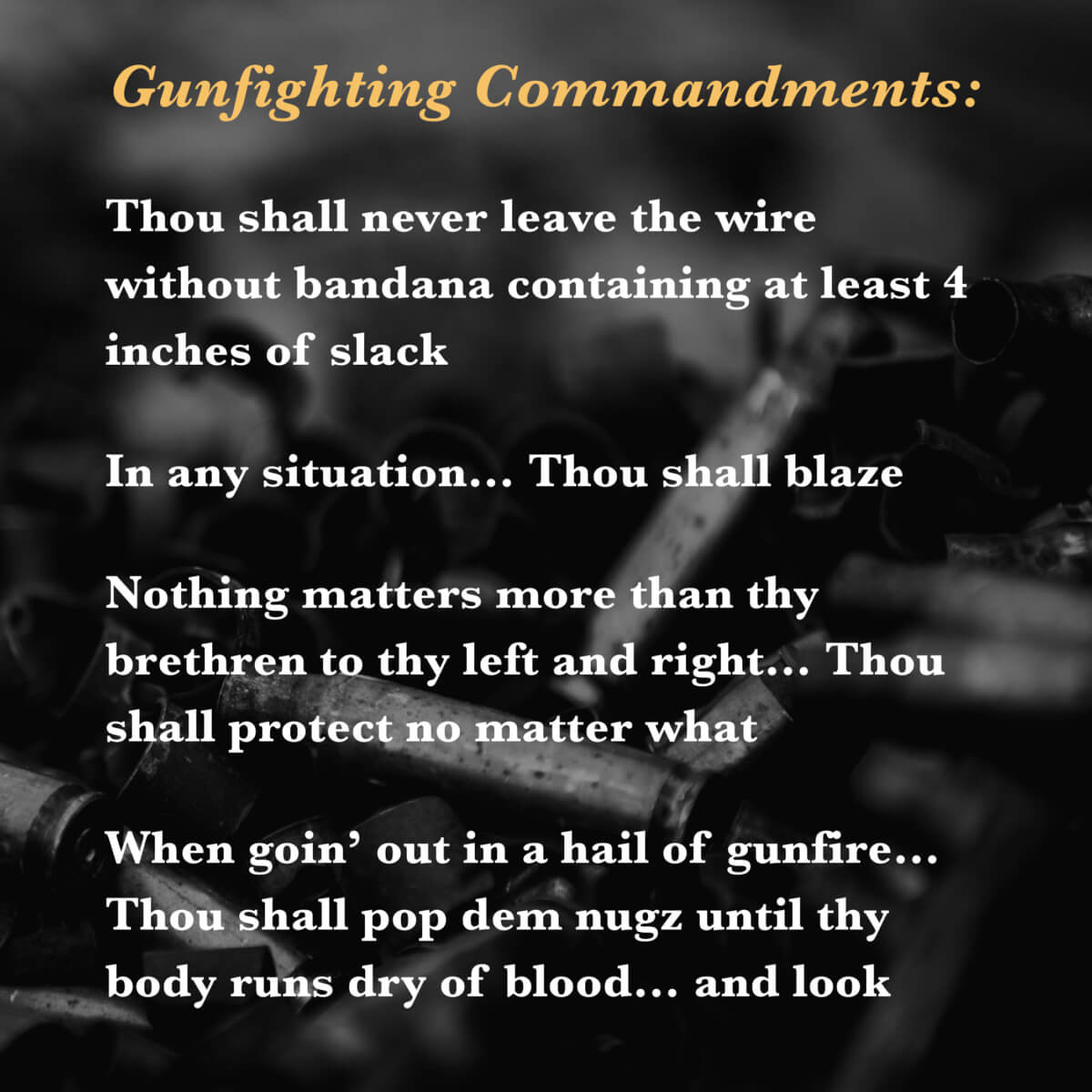
John: Matt came up with this thing called, “slack” in his bandana. Matt loved bandanas. His first gunfighting commandment was, “Thou shall never leave the wire without a bandana containing at least four inches of slack.” He’d always say it in his surfer voice and it was funny as hell. The slack was the loose ends of the bandana dangling like a ponytail. We’d be getting ready to go out and he’d be like, “Ok everybody, get your slack” as he’s tying on a bandana before he put his helmet on. I still do it to this day when I ride my motorcycle.
Britt: The gunfighting commandments were just Matt’s mentality towards wearing the uniform that were unspoken but lived. Not necessarily the words themselves, but the attitude he took towards everything. He so much loved wearing camouflage, sweating, and carrying guns with the potential of blasting holes in people, and he lived that. He could have written the gunfighting commandments a million different ways, but it all would have said the same thing; look cool, feel cool, protect your homies, and kill the people trying to kill you. In the least eloquent way, that’s just who he was.
Jake: His rules of war I think were based off something he read in a book but he put his own spin on it, but it hit home for all of us. Someone’s got to walk point, that was just reality, and some of us weren’t going to go home. I think what separated Matt from the rest of us was that he had already accepted that before we even got there. John, too, already knew. He had significant combat experience and was blown up by an IED in Iraq. He knew the consequences of what we were going to deal with and was ok with it. I guess the wild part for Matt is that he was prepared for the reality, but had not yet experienced anything like it. By the time we left Afghanistan, we all could all go out and we knew what we were looking for, we knew what the contact would be like, we knew we could step on an IED, but that fear was kind of gone. Matt was like that from day one. I think his gunfighting commandments and rules of war were just helping the rest of us get accommodated.
“It felt totally unreal to all of us. Everyone felt very mortal in Sangin, but nobody thought you could touch Matt. He was invincible. We all just felt like, 'If Abbate can get killed out here, there is no way I’m going to survive this shit.'"
— Britt Sully
The One in Ten Million
Britt: On Dec. 2, 2010, me and Jake had just come back from a two-man sniper operation. We went out at dawn and came back four or five hours later with nothing really happening. I’d been back inside the wire for maybe 30 minutes cleaning my gear and refilling my water. We heard a gunfight start up in the distance. We heard the radio traffic and it sounded like Matt and the rest of the guys out there totally had the initiative, but I geared back up just in case they needed a QRF. The guys saw some Taliban go inside a building. On the radio, we heard jets get called in for air support. We watched both birds go overhead and we watched both bombs drop. We had made a habit of calling in the first bird to drop a short delay 500 pound bomb so that it would penetrate inside the building and blow it up. The second bird would follow up with an air burst above the same target to kill anyone who survived the first drop and was trying to flee.
Maybe 30 seconds after the second bomb dropped we hear that there is an urgent surgical wounded. Abbate threw his gun back up on the berm and started scanning for somebody to shoot after the first bomb. Just the geometry of chance unluckily caught him in the neck with a piece of metal from the second bomb. We didn’t know that then, we just heard Abbate’s kill number come across the radio. But I’m thinking, “Matt will be fine. He’s Abbate. Nothing can touch him.”
Jake: Within a few minutes of the medevac bird taking off, we all received notification that we were “River City,” which means that we’ve got somebody dead and all communications with home were cut off to prevent anyone from communicating with the Marine’s family. My heart sank; just gut wrenching. I was trying to reach our Kilo Company HQ to confirm what we just heard because I just couldn’t believe it. I ran up to the patrol base’s comm shack and got on the radio. I said, “Kilo main, this is Banshee, confirm your last traffic.” Our Forward Air Controller, a great guy, came back and was just like, “I’m so sorry Banshee.”
Britt: It felt totally unreal to all of us. Everyone felt very mortal in Sangin, but nobody thought you could touch Matt. He was invincible. We all just felt like, “If Abbate can get killed out here, there is no way I’m going to survive this shit.” His death reverberated through the entire battalion.
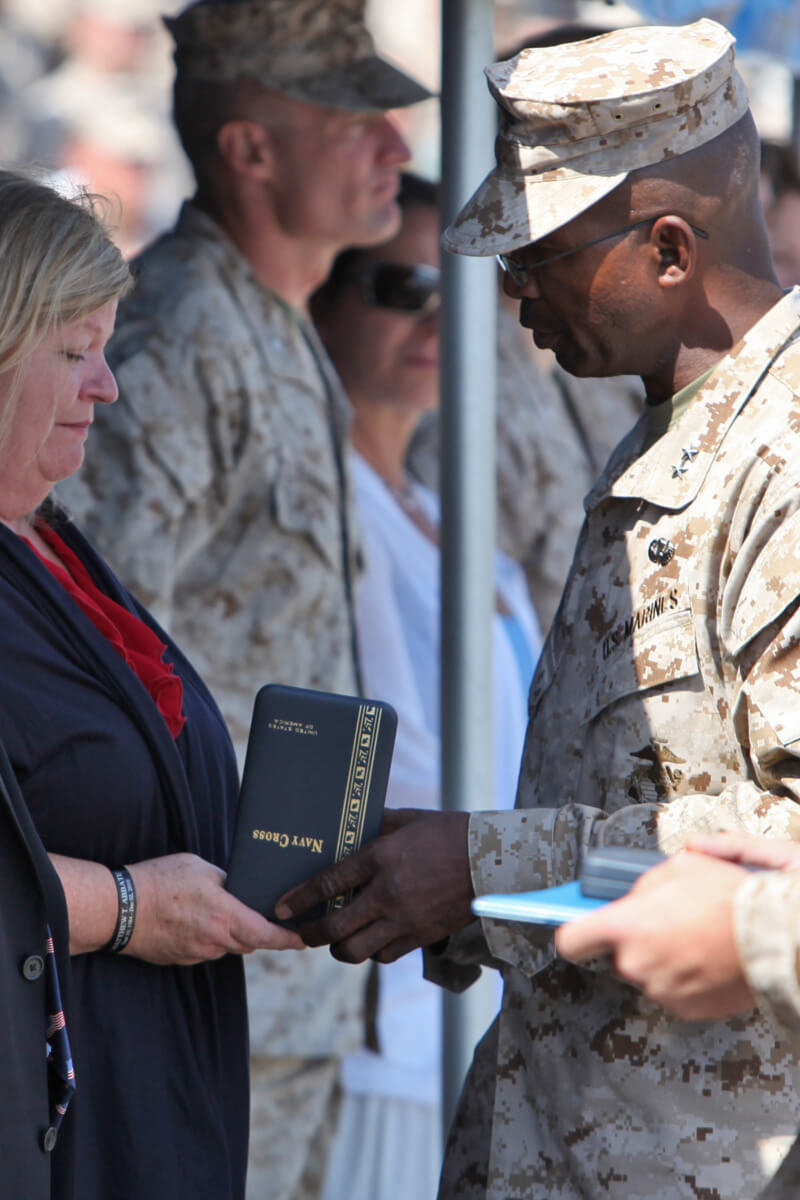
MajGen Ronald L. Bailey presents the Navy Cross to Sgt Matthew Abbate’s mother during a ceremony aboard Camp Pendleton, Calif., Aug. 10, 2012. USMC Photo
Jake: Our deployment to Sangin 100% shaped everything about the remainder of my time in the Marine Corps, and still does to this day. Matt’s relentless nature in everything he did, his relentless drive to be the best and outperform his best, pushed me to be a better performer and made me push my Marines to outperform their best. For young Marines today, you have to be relentless. Matt never had an ounce of quit and never left anything on the table. As a Marine, you can’t have any quit because, ultimately, no matter what you do the enemy always has a vote.
Britt: Be as excited and proud to wear the uniform and do the job that you were the day you went to MEPS. When you didn’t know any better, when you didn’t know how stupid the games could be, when you didn’t know how lame the regulations are, and all the things it takes to get to wear the uniform and do the job; just show up every day excited to wear that uniform. Matt was just excited to get to be a Marine. To take off his uniform drenched in sweat and dirt, sore from trudging up hills carrying a machine gun. That was a good day to Matt.
It’s tough to call him anything close to an example of a window into what the Marine Corps was like during our era because Abbate was truly one in 10 million. I don’t know how many Marines served in the GWOT, but in that 20 years there are only a few other dudes that had the impact on the people around him and the larger-than-life impact in the day to day. His exemplary character, attitude, and performance in everything he did had so much gravity. Everyone who served with him on a day to day basis knew this guy was what you think of when you think ‘real Marine.’ When I say ‘real Marine,’ I don’t mean text book recruiting poster, handsome, barrel-chested, shaved face dude. I mean absolute fucking killer, that’s a libo risk, that takes care of his dudes and leads from the front.
Jake: Matt taught me that you have to love your subordinates, whether you like them or not. He took every opportunity to train hard. He was the epitome of a Marine. He set the standard that I strive to reach, both through my time in the Marines and my current career in law enforcement. The lessons that I learned by watching Matt have shaped my entire adult life. I count myself very fortunate to have known him.
Author’s Note: Matt Abbate was 26 years old at the time of his death. He was survived by his wife, Stacie Rigall, his son, Carson Abbate, his mother, father, and three siblings. 3/5 remained in Sangin until April 2011. The battalion suffered 25 killed in action, and more than 200 wounded. Throughout the entire 20-year war in Afghanistan, 3/5 suffered the worst casualty rate of any Marine battalion.
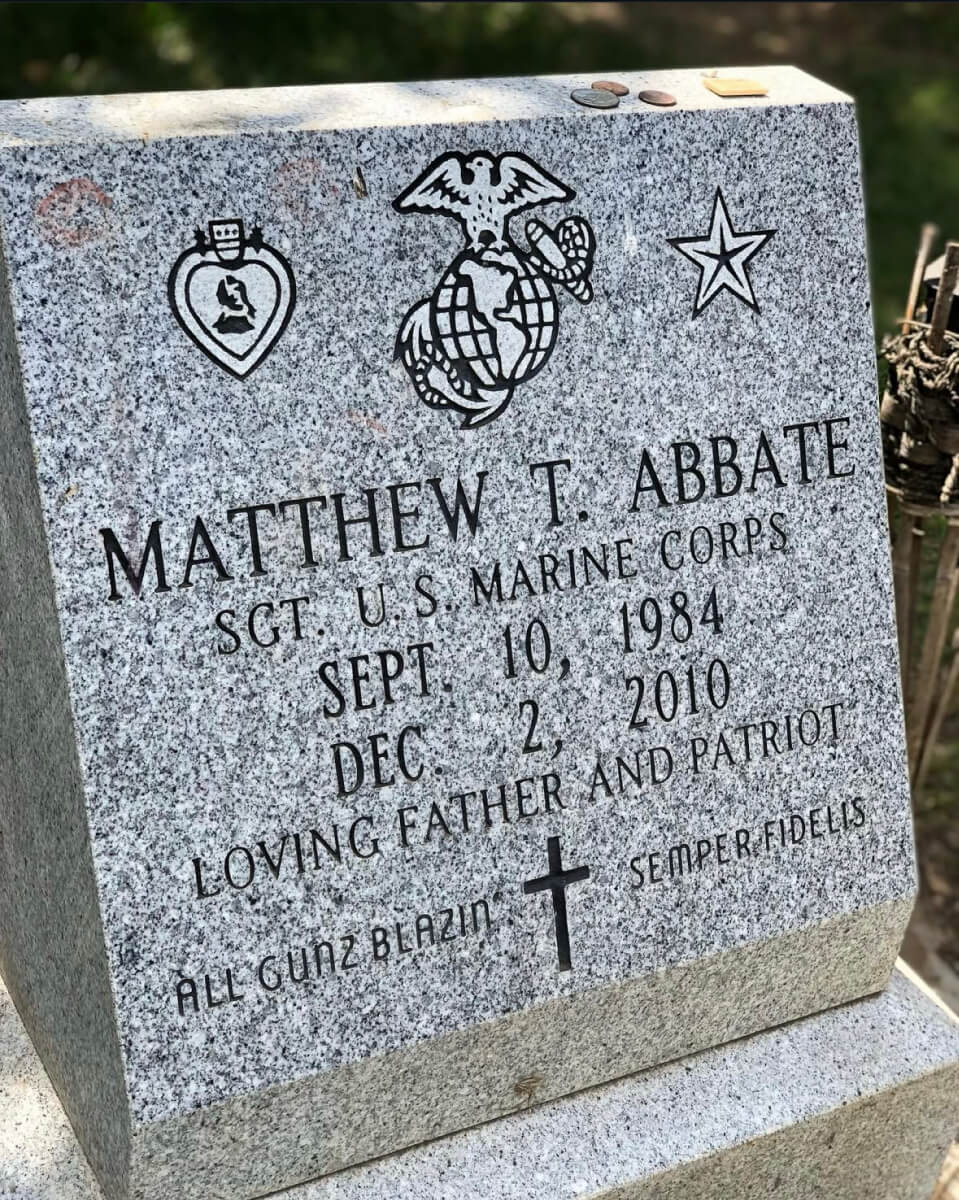
Courtesy of PB Abbate
Originally published in Leatherneck magazine, October 2025.
What's your Abbate story? To join the comments on this story, return to the All Guns Blazin' home page. Thank you for taking part in these veterans' story.